


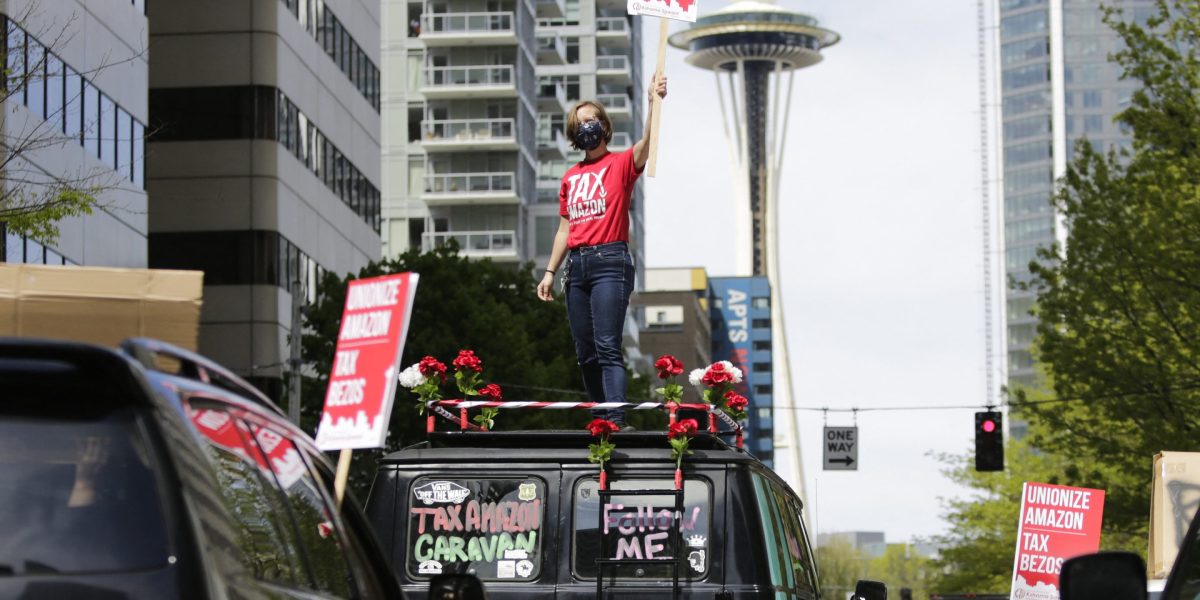
After a grueling 25 hours of debate on the House floor, complete with an almost show-stopping filibuster effort of more than 80 amendments by Republicans to stop the bill from moving forward, Washington made history this week with the passage of a millionaires tax bill, which would create the first income tax in the state’s history.
On March 9, lawmakers passed a 9.9% tax on personal income above $1 million per year—a first for the income-taxless state. The final vote was 52–46, and involved the longest floor debate in Washington history, far exceeding the previous record of nine hours.
“We knew it was going to be a pretty major endeavor,” Rep. Brianna Thomas, a Democrat who supported the measure, told Fortune. “We’ve got 93 years of precedent in front of us, behind us, around us at all times on the conversation around an income tax.”
Washington was one of only nine states with no income tax, and has operated on essentially the same tax structure—reliant solely on sales and business taxes—since it was built on an agrarian, timber, and shipping economy in the early 20th century. Washington last voted on an income tax in 1932, when it passed overwhelmingly, only to be struck down by the state Supreme Court a year later on the grounds that income is classified as property under the state constitution, requiring a uniform taxation scheme. In 2010, state legislators attempted to introduce another income tax, only this one didn’t even come close to passage.
For Thomas, the economy has simply outgrown the code. Washington has now become the home of global multitrillion-dollar organizations Amazon, Microsoft, and Boeing, and it’s staring down a projected budget deficit of $10 billion to $12 billion over the next four years.
“Washington state was originally built on an agrarian and timbered economy,” she said. “We still have a tax code based on apples and cherries while building some global-leading technology every which way you throw a rock.”
The result is a tax structure that economists have consistently ranked among the most regressive in the country. According to the Institute on Taxation and Economic Policy, the top 1% of earners in Washington pay just 4.1% of their income in state and local taxes. The bottom 20%, however, pay 13.8%.
“We’ve got more millionaires and billionaires than we’ve ever had, and they’re paying, effectively, a 4% tax rate,” Thomas said. “Meanwhile, you got working folks paying 11% of their income, and the lowest-income people paying 14%. Isn’t it unfair for those who have the most, to pay the least, and those who have the least to pay, the most, proportionally?”
The bill imposes a 9.9% tax on personal income above $1 million annually, affecting roughly 21,000 filers, or less than 1% of Washington’s population, and is projected to generate $3.5 to $4 billion per year once it takes effect in 2029. It also includes tax relief for everyone else: sales tax exemptions on diapers, over-the-counter medications, and personal hygiene products, plus an expanded Working Families Tax Credit.
Passage wasn’t clean. The House considered 81 amendments over 25 hours, with Democrats working to bring their own members along.
“There was not unified assent for the bill on the Democratic side,” Thomas told Fortune.
The Senate then passed a concurrence vote 27–21 (speaking with Fortune prior to the Senate’s vote, Thomas joked the 25 hours of debate would likely deter any similar debacle from occurring in the Senate: “The Senate will concur, because they don’t want to do a 25-hour floor battle. That’s just not how the Senate rolls.”) The bill now heads to Gov. Bob Ferguson, who has signaled he will sign it.
But Thomas was careful about what victory actually means.
“We’ve got to let it sit,” she said. “We have to get through our own Supreme Court review again, and it still has to go to a vote of the people. There are many miles to go before this is actually the law of the land.”
Washington gets a millionaires tax, others push one for billionaires
Washington’s bill is the most concrete step yet in a wider national push to tax extreme wealth. Recently, Sen. Bernie Sanders (I-Vt.) and Rep. Ro Khanna (D-Calif.) introduced the “Make Billionaires Pay Their Fair Share Act,” a proposed 5% annual wealth tax on the roughly 938 Americans with a net worth above $1 billion, a group Sanders says collectively holds $8.2 trillion. In its first year, revenue would fund a one-time $3,000 check for households earning $150,000 or less; going forward, it would target Medicaid, teacher salaries, and childcare costs. Sanders projects the bill would generate $4.4 trillion over its first decade.
Similarly, in California, a labor union put forward the 2026 Billionaire Tax Act, a ballot initiative that would impose a one-time 5% tax on residents with a net worth above $1 billion. If passed, it could generate approximately $100 billion in one-time revenue, directed toward healthcare and food assistance.
“The haves have more than they’ve ever had,” Thomas said. “The have nots have less than they’ve ever had. That’s just not going to be sustainable for everyday folks.”
Almost immediately after the bill passed, billionaire Starbucks founder Howard Schultz announced he was swapping Seattle for Miami, where he recently paid $44 million for a penthouse. Although he has not confirmed the passage of the bill is why he chose to leave, Schultz, who is worth $6.6 billion, wrote on LinkedIn he hoped Washington would “remain a place for business and entrepreneurship to thrive.”
He also isn’t the first to leave Washington. Amazon founder Jeff Bezos similarly moved to Miami in 2023, costing the state an estimated $954 million in tax revenue in 2024 alone. When Bezos sold 50 million Amazon shares that year from Florida, he saved an estimated $610 million in state taxes by no longer being a Washington resident.
Despite Schultz’s departue, Thomas didn’t flinch. “I certainly hope Washington is more than a spreadsheet or a tally sheet to someone,” she said. “This isn’t a math problem to me. This is a policy problem rooted in the fact that I care about my community.”
