

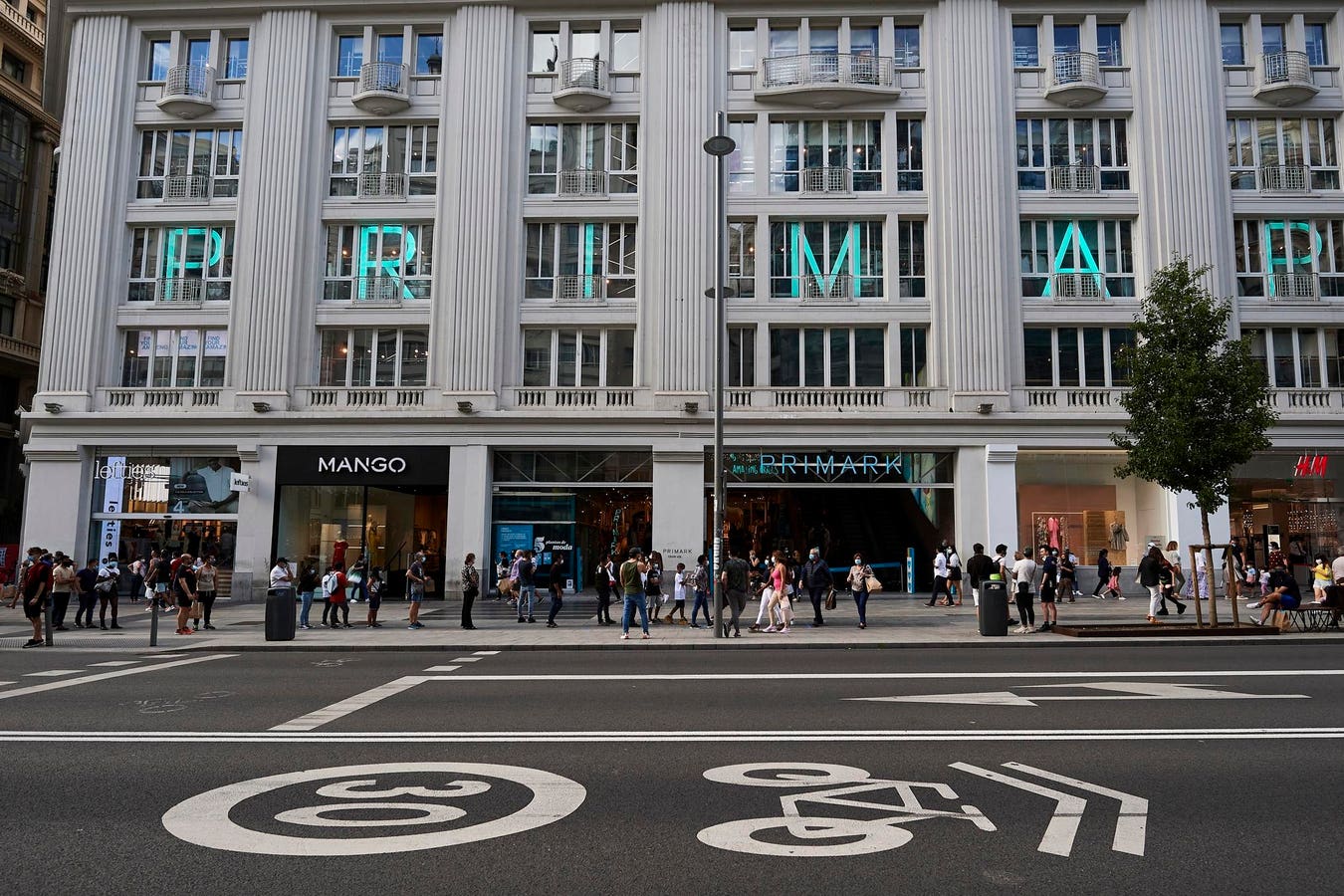
MADRID, SPAIN – JUNE 15: Shoppers queue in a line to enter the Primark store on June 15, 2020 in Madrid.
Getty Images
Although ‘fast fashion’ has become fashion’s sustainability scapegoat, with luxury fashion brands pointing the finger and calling it the industry’s culprit, including Antoine, son of billionaire LVMH-owner Bernard Arnault, who famously declared on stage at fashion’s premier Sustainability Summit that luxury goods are “sustainable by nature.” LVMH’s emissions prove otherwise.
Inconveniently for Arnault, research by the Environmental Charity Hubbub, in partnership with the University of Leeds, conclusively refutes the myth that cheaper fashion items are more ‘disposable’ than luxury items. Luxury prices do not guarantee quality or longevity.
Back in 2022, Hubbub and the School of Design at the University of Leeds designed a study funded by Primark to explore the relationship between garment durability and price.
Founded 50 years ago by Associated British Foods, the Primark fashion brand aims to provide affordable clothing choices for everyone. With 70,000 employees and 450 stores in 17 countries, the brand’s accessibly-priced fashion once earned it the nickname ‘Primarni’ in the 2000s–a time when it featured alongside high-end fashion brands in British Vogue, Grazia, and other fashion publications. Now, glossy magazines are steering clear of Primark, as are most journalists–particularly sustainability ones.
Since then, Primark and other ‘value-led’ brands have felt the sharp end of social and environmental criticism as climate change and supply chain tragedies have thrust them into the spotlight, tarnishing them in a way that luxury brands falling foul of the same crimes hasn’t. (The most recent case of such double standards may be the farmer exploitation by cashmere brand Loro Piana, whose jumpers retail for as much as $9000.) As such, researchers set out to discover whether price correlates with quality.
MORE FROM FORBES ADVISOR


The 2022 study was built from existing durability guidelines in The Clothing Longevity Protocol by the UK-based NGO Waste and Resources Action Programme and the Ellen MacArthur Foundation’s Circular Business Models. The study, titled “Worn Out: Is Price an Accurate Indicator for Clothing Durability,” included performance testing, including textile abrasion, seam strength, fading, and shrinkage, combined with repeated washing and drying cycles in domestic washing machines to assess how the garments were affected by laundry. An iterative process for analysis of the results throughout the testing cycles was used to show how likely it would be for the owner to reject, return, or stop wearing a garment.
Alex Robinson, CEO of Hubbub, said in an interview that “the tests were developed independently and analyzed 65 clothing items across three categories,” including t-shirts, jeans, and hoodies. The items were segmented in price intervals of £10 ($13) for the jeans and hoodies and £5 ($6.70) for the t-shirts. Robinson explained that Primark’s involvement extended only to “what would be investigated in the research,” and the study itself was designed, implemented, analyzed, and reported without Primark’s involvement. So, what were the results?
Researchers testing clothing durability in the Materials Testing Lab at the University of Leeds.
Leeds Institute for Textile and Colour (LITAC)
For womenswear denim jeans, the most expensive products tested ($160 – $200) performed best and were ranked most durable. However, one product costing between $121 – $160 performed very poorly. The jeans priced between $30 – $40 and $15 – $30 performed very well and were ranked second and third. Overall, the test results showed little difference in durability performance between the most expensive and the two lower-priced products, making up the top three rankings, even though the price difference was as much as $134 between the first and third garments.
Similar results emerged from the t-shirt tests, where two of the top three performing t-shirts for women and men were lower priced, costing under $6.70 or $6.70 – $13.30.
“There isn’t a correlation between price and durability,” explained Robinson, adding that another interesting finding had been consumer attitudes to clothing prices: “Consumer polling showed not only do people believe that more expensive clothes are better quality, but that they are more likely to look after more expensive clothes.”
Robinson said that “a self-fulfilling prophecy occurs and may contribute to durability,” meaning we maintain expensive clothes carefully, giving the false impression they are inherently better quality. “This [research] proves all clothes deserve to be cared for,” irrespective of price, says Robinson.
These findings are supported by separate research published in 2020 at the University of Otago in which a survey showed that more than 50% of consumers would discard a low-priced T-shirt (NZ$0-10) ($0-6.15) after 10 washes. However, the performance of the two lowest-priced T-shirts that were tested (A: NZ$4 ($2.15) and B: NZ$9 ($5.50)) highlight that price is not necessarily an indicator of performance as they responded very differently to laundering. The research also reiterated that consumers tend to use price as an indication of quality.
Researchers testing clothing durability in the Materials Testing Lab at the University of Leeds
Leeds Institute for Textile and Colour (LITAC)
How did the Hubbub research findings inform Primark’s new durability framework, published this week, and what does the false ‘low price, low utility’ consumer belief mean for Primark as a ‘low price’ retailer?
Primark’s durability framework is part of the Primark Cares Strategy, which spans products, planet, and people. The durability framework helps fulfill their commitment to extend the garment lifespan and facilitate care and repair, keeping clothing in use and out of landfill for longer.
WRAP lent its own study findings to Primark’s framework, where it found that extending the life of clothing by an extra nine months reduces carbon, waste, and water footprints by as much as 30%–each. Extending use, then, would appear to be connected to Primark’s Science Based Targets, including halving its emissions across its entire value chain by 2030. Despite the link between clothing care and extending its lifespan, the fashion industry has no universal standards for clothing durability, hence Primark’s establishment of its brand-specific framework.
Since January this year, Primark’s durability framework has been implemented with all its suppliers, adding around seven days to the production time due to extra testing. The framework includes physical testing and repeated washing (up to 45 times) that simulates domestic washing to ensure that the results reflect how clothing performs throughout its lifetime. Primark says some clothing items meet the required standard after testing and don’t need any improvements, while others may need small tweaks, such as zip adjustments. They say the changes don’t always mean producing a more durable product is more expensive.
Product Longevity and Partnerships Lead at Primark Cares, Vicki Swain, said during an interview that the Primark team is “now building a database of machine washable clothes statistics and working towards which [ones] to change” to give optimal care advice to consumers and extend the life of each product.
“Over 50% of [Primark’s sales] volume is ‘basics’—meaning everyday essential clothing—including t-shirts, socks, joggers, underwear and hoodies,” Swain explained, highlighting the importance of longevity in products worn regularly. Simultaneously, this statistic illustrates that half of Primark’s sales are unrelated to ‘trend-led’ or seasonal fashion, calling into question popular commentary that assumes Primark is synonymous with disposable ‘fast-fashion.’
When probed, a Primark spokesperson revealed by email that “more than half of our stock is perennial items always in stock, 365 days per year,” meaning no inbuilt obsolescence. They added: “Our market knowledge and operating model means we typically have very little unsold stock. Anything left is resold or reused via our charity partner. We also have a zero landfill policy”.
In an interview, Lynne Walker, Director of Primark Cares, explained, “We are taking [sustainability] very seriously,” adding “there is an element of future-proofing in relation to incoming European legislation, and we will be compliant.” Walker alludes to increased textile product regulation, including the new Ecodesign for Sustainable Product Regulation and Extended Producer Responsibility regulations. Regarding the latter, brands will pay a fee for each product sold on the market to offset the cost of waste handling when those garments are discarded.
Such EPR schemes can include an ecomodulation opportunity, whereby brands pay fewer fees if their products are more durable and made of lower-impact or recyclable materials, for example. Walker says Primark’s new durability framework is part of the preparation for this new regulation but is also necessary to maintain the brand’s ‘license to operate’ in the age of climate change and increased consumer concern about clothing’s environmental impacts.
Primark is a member of the Textiles 2030 initiative in the United Kingdom, a voluntary scheme with signatory brands committing to environmental targets and progress on the Textiles 2030 Circularity Roadmap. Bur Walker cautions “[Although] Textiles 2030 is about setting guidelines, it’s not quick enough”. With the European ESPR already entered into law this year and digital product passports (containing product impact, care, and repair data) to follow, the UK’s 2030 ambitions are somewhat off-the-pace for UK brands selling products in Europe.
While Primark has taken the plunge to publish its durability framework and extend the life of products, how might consumers respond? If behavior dictates that inexpensive clothes aren’t cared for well, how should consumers be educated on better care practices for all clothes? To that end, Primark has conducted over 50 in-store workshops teaching customers basic repair skills and has established a thriving community in the process.
Primark Love it for Longer in-store garment repairs workshop.
Primark
With consumer attitudes skewed toward caring for expensive items and punishing cheaper ones, should Primark consider raising retail prices? Walker declares the retailer remains staunchly dedicated to offering affordable fashion for all, meaning that price inflation to garner improved garment care isn’t on the cards. Primark’s very low pricing does remain the elephant in the room when grappling with its environment and ethical sustainability credentials. Brands may produce a $9000 sweater unethically, but can a $5 t-shirt ever be produced ethically and sustainably?
A Primark spokesperson says yes, explaining in writing the elements of its business model that allow for such keen pricing. These areas of leanness include not selling online (and therefore removing the burden of expensive delivery and returns), comparatively tiny marketing budgets (instead relying on their 24 million-strong social media community to share and discuss the product), and placing very large orders with suppliers well in advance to achieve economies of scale, then adding a far lower retail margin for the brand compared to competitors.
Price is clearly not a proxy for quality, and no product can be considered “sustainable by nature.” However, a challenge remains in shifting consumer perception and behaviors to care for Primark as carefully as it might Prada.
This article was updated on 7/10/24 to include the University of Otago research.
