

The landmark exhibition ‘Kings and Queens of Africa: Forms and Figures of Power’ celebrates Africa’s royal legacy and artistic influence, presenting over 350 artefacts from across the continent alongside striking artworks by contemporary African and diaspora artists — by Brendon Bell-Roberts
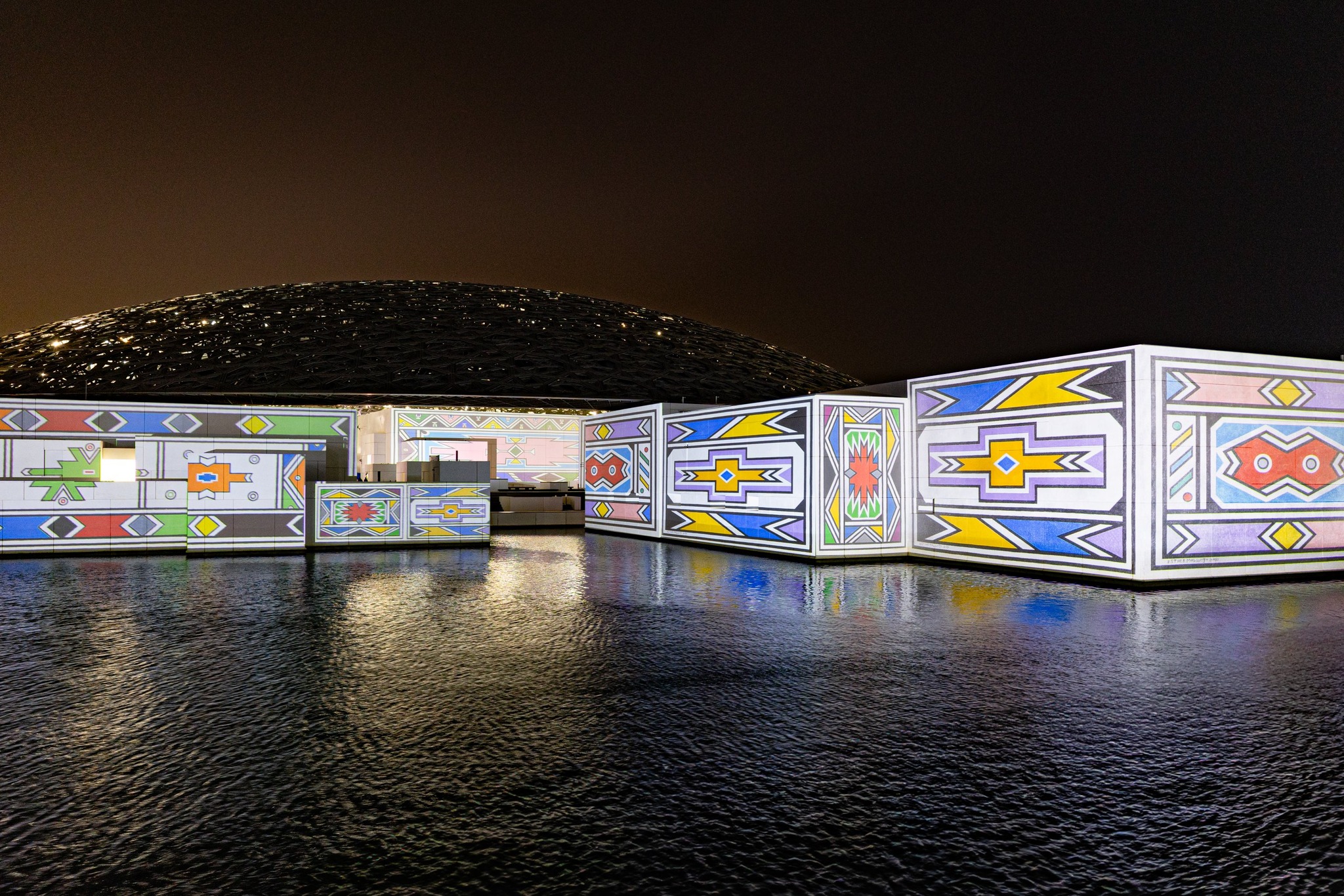
Esther Mahlangu projected on the walls at the Louvre Abu Dhabi.
‘Kings and Queens of Africa: Forms and Figures of Power’ has opened at the Louvre Abu Dhabi, marking a significant moment as the first exhibition in the UAE dedicated to African art. Presented in collaboration with the Musée du Quai Branly – Jacques Chirac and France Muséums, and supported by various international institutions, the exhibition showcases over 350 exceptional objects from West, Central, Southern, and East Africa, offering a profound exploration of Africa’s artistic and cultural legacy from the 11th to the 21st centuries.
Curating an exhibition that spans centuries and the breadth of an entire continent is a bold undertaking—one that is as intricate as it is ambitious. Curated by Hélène Joubert, with with assistance of curators El Hadji Malick Ndiaye, and Cindy Olohou, with support from the Louvre Abu Dhabi curatorial team, this exhibition charts a nuanced cartography of royal power, cultural identity, and artistic brilliance across sub-Saharan Africa, offering not a definitive account but a series of thoughtful entry points. To frame the vast and varied region historically known as Aethiopia, “Black Africa,” or sub-Saharan Africa through the lens of kingship and the iconography of power may seem, at first glance, both audacious and reductive. Yet it is within this tension that the exhibition finds its strength. As Joubert notes, “This exhibition does not claim to be exhaustive. Visitors will not find a list of all the kingdoms, past and present, that ever existed on the continent. Nor will they encounter a single, multi-voiced historical narrative. What they will find are objects of power and prestige—each with a story, even if incomplete.” She adds, “One exhibition cannot do full justice to the theme, since power took many forms.” What unfolds instead is a rich visual and conceptual tapestry—fragmentary yet evocative—through which African history, sovereignty, and artistic legacy are illuminated with renewed urgency and reverence.

Installation view with large wall hung work by Abdoulaye Konate, ©Department of Culture and Tourism–Abu Dhabi. Photo: Ismail Noor/Seeing Things
The exhibition presents objects and forms historically associated with power, prestige, and authority, including regalia, courtly portraits, ritual instruments, sacred statuary, and textiles of sublime craftsmanship. They offer a window into the breadth of African creativity, transporting us across time and place—some precisely mapped, others shrouded in mystery. Some objects date back many hundreds of years; others are freshly imagined works by contemporary African artists who wrestle with the complex legacies of leadership, cultural continuity, and colonial rupture. The evolving relationship with African art—from its early, often problematic classifications as “primitive” or “tribal” art (terms still in use when the Musée du Quai Branly first opened) to its recognition as a cornerstone of non-Western aesthetics—sparked an artistic revolution in which Africa continues to be a dynamic and enduring source of inspiration; these artworks do not merely illustrate history—they animate it.
The result is a sprawling yet deeply considered presentation of over 350 objects—historical artefacts and contemporary artworks alike—that transport viewers from the thrones of West African kingdoms to the sacred ritual spaces of Central and Southern Africa. The exhibition’s unique approach, which resists the notion of a grand, unified narrative, is sure to intrigue and engage viewers. Instead, it emphasises the objects—each imbued with memory, mystery, and meaning—and allows them to speak in powerful tongues.

Installation view with photography work by Samuel Fosso, ©Department of Culture and Tourism–Abu Dhabi. Photo: Ismail Noor/Seeing Things
The exhibition aims to dissect the intricate ways these figures have shaped their times’ sociopolitical and cultural landscapes and how their legacies continue to resonate in the newfound African Renaissance, framing a discourse marked by remembrance and a reconceptualisation of African history and agency. El Hadji Malick Ndiaye, curator of the Theodore Monod Museum of African Art, also emphasised that the contemporary art segment showed how dynamic and vibrant African culture is. The African Renaissance, a term first propelled into the modem lexicon by the philosopher Cheikh Anta Diop (who was of royal descent) in the 1940s and later popularised by leaders like the South African President Thabo Mbeki, embodies the aspiration of Africa’s peoples to transcend the legacy of oppression and forge a path of spiritual, cultural, intellectual, and economic renewal.
Click here to read more about the exhibition in the ART AFRICA , ISSUE 25, CARRYING CHANGE.
