

A mere month ago, luxury businesses were looking forward to a new era of deregulation, lower taxes and a booming stock market — and dreaming of well-heeled buyers splurging on opulent ball gowns and statement watches.
Instead, as the Trump administration imposes 20 percent tariffs on products from the European Union, they are bracing for a different reality. One that may mean a U.S. market with fewer quilted Chanel bags, more expensive Rolexes and uncertainty about the price tags attached to “Made in Italy,” “Made in France” and “Made in Switzerland” for American consumers. The same consumers who, last year, were responsible for 24 percent of the total $1.62 trillion global luxury spend, according to Bain & Company.
“The U.S. was supposed to be the savior of the luxury goods industry,” said Euan Rellie, co-founder of the investment bank BDA, which works in the fashion industry. “The Trump administration has said overnight, ‘We’re not going to play ball.’ Luxury is in a very tough spot.”
It was already challenged, hurt by the slowdown of luxury sales in China, a recession in Germany and an aging Japanese population. Now, with the huge U.S. market facing uncertainty, no brands seemed in the mood to discuss how tariffs might affect their businesses or the prices of their products.
A spokesman for LVMH, the largest luxury group in the world, with over 75 brands including Dior, Louis Vuitton and Fendi, declined to comment — even though the United States accounted for 25 percent of the group’s revenue in 2024, and Vuitton is the sole European luxury brand to have factories in the United States. (President Trump cut the ribbon at a Vuitton factory in Texas during his first term, and the LVMH chief executive, Bernard Arnault, attended the recent Trump inauguration with two of his children.)
Burberry declined to comment, as did Chanel. There were no comments from Hermès, Kering (owner of Gucci, Balenciaga and Saint Laurent, among other brands) and Puig (Carolina Herrera, Rabanne and Dries Van Noten). Coach and Tory Burch, too, preferred to stay mum.
Doug Hand, a fashion lawyer who works primarily with independent American brands that source their materials from overseas, described his clients as “biting their nails and pulling their hair out.”
Andrew Rosen, an investor and adviser to independent American brands such as TWP, Veronica Beard and Alice & Olivia, said, “I don’t even know what the cost of our merchandise will be next week.”
Many luxury brands have big profit margins and can absorb some of the costs, or press their suppliers to reduce theirs, but analysts predicted that prices would go up — if tariffs stayed in place.
“Most people in their right mind are thinking they should just wait,” said Luca Solca, a senior analyst covering luxury at the research firm Bernstein. “The volatility of U.S. policy in the last two months has been wild. The president might change his mind, or he might cut a deal with the E.U.”
Certainly, no one is planning to build upscale apparel and leather-goods factories in the United States, one of the stated goals of the administration’s tariff policy.
“In every single conversation I have had with clients over the last five to 10 days, not a single person was talking about building a factory in the U.S.,” said William Susman, a managing director at the investment bank Cascadia Capital, who has worked with Victoria Beckham and Tommy Hilfiger.
Asked if he was considering such a move, Brunello Cucinelli, the founder of his namesake brand, said he had no such plans. “Made in Italy is at the core of our identity,” he said. “Our company is Italian, and we will continue to be based in Italy.”
In the 1950s and ’60s, roughly 98 percent of the clothes in closets in the United States were made in America. Today, the total is around 2 percent. It would take years to rebuild a viable apparel industry, said Denise N. Green, an associate professor and the director of the Cornell University Fashion and Textile Collection. Even companies that make clothing in the United States do so with zippers and buttons from China, wools and leathers from Italy, and cashmeres from Mongolia.
That is why, said Mr. Solca of Bernstein, if the 20 percent tariffs on goods from the European Union and 31 percent of goods from Switzerland go through, “Americans will pay a lot more.”
And that is why, said Mr. Rosen, “this isn’t a tax on countries — it is a tax on American companies and American consumers.”
Of course, if any consumer can absorb higher costs, it is the luxury consumer. Conventional wisdom has it that even in a downturn, luxury is resilient; the rich, while less rich, are still comfortable enough to indulge their tastes for expensive goods. In that sense, the prospects for luxury are better than those of mass-market brands that produce in Vietnam and Cambodia and have smaller profit margins while facing even higher tariffs.
Still, not all luxury consumers are the same, financially speaking. Achim Berg, the founder of Fashion Sights, a luxury industry think tank, said that about 70 percent of luxury buyers were “affluent and aspirational customers,” rather than the kind who didn’t mind whether the price of a $750,000 Lamborghini went up by $100,000. Those customers, hit by both shrinking stock portfolios and fears of a recession, may opt against discretionary purchases such as handbags or diamond tennis bracelets.
People buy indulgences when they are feeling confident and optimistic, and the general environment now, Mr. Berg said, is one of “insecurity.”
Tariff-related costs would come on top of years of luxury price increases. Chanel bags, for instance, more than doubled in price between 2016 and 2023. And that could contribute to an already “negative perception,” of luxury brands, said Claudia D’Arpizio, the global head of the fashion and luxury practice at Bain & Company.
“They were already in a moment where they needed to recover customer trust, so this is not going in the right direction,” she said. “There is an overall negative feeling in society against products that are only for the superwealthy.”
Even in a downturn, however, “there will be winners,” said John Demsey, the former executive group president of Estée Lauder.
Sellers of vintage designer goods could benefit from all the upheaval. “I’ll be watching the luxury handbag sales at Christie’s and Sotheby’s closely,” Mr. Susman said.
Jacek Kozubek, a vintage Rolex dealer, said one of his biggest partners in Japan, where many of his best pieces come from, flew to the United States last week with more than 400 watches, ahead of the anticipated tariffs. Mr. Kozubek bought 50 watches to the tune of $300,000.
Mr. Solca said it was possible that a gray market might develop in the United States, much like the Daigou system in China, in which individuals buy luxury goods abroad, sneak them into the country and then resell them for a profit.
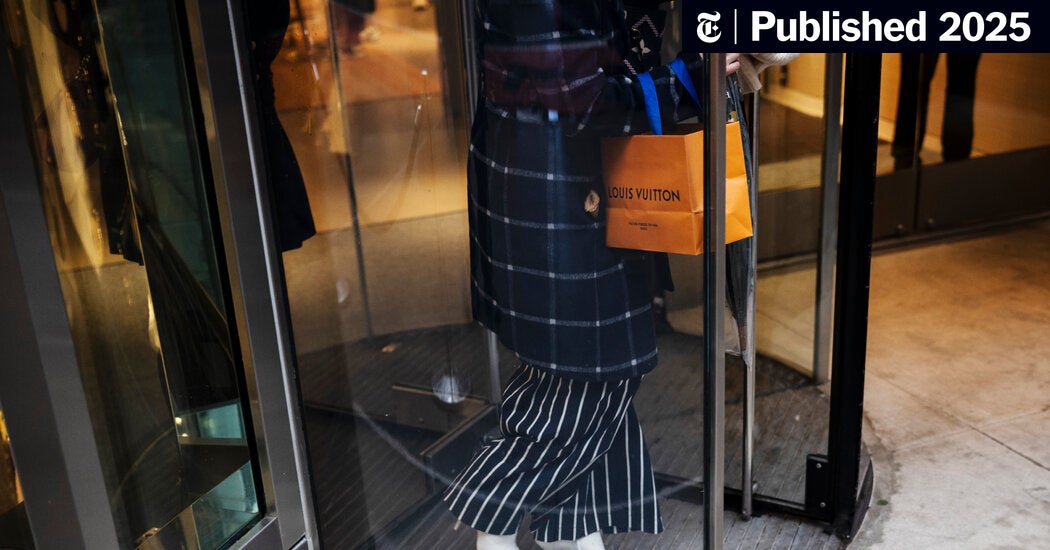
And there is one trend all the luxury analysts assume will re-emerge: “silent luxury,” the aesthetic of the 2008 recession, when consumers left stores with purchases in plain paper bags and visible logos fell out of favor.
“Even people who can still afford it might have luxury shame,” Ms. D’Arpizio said. “They might not want to be so show-off, wearing something that is instantly recognizable.”
