


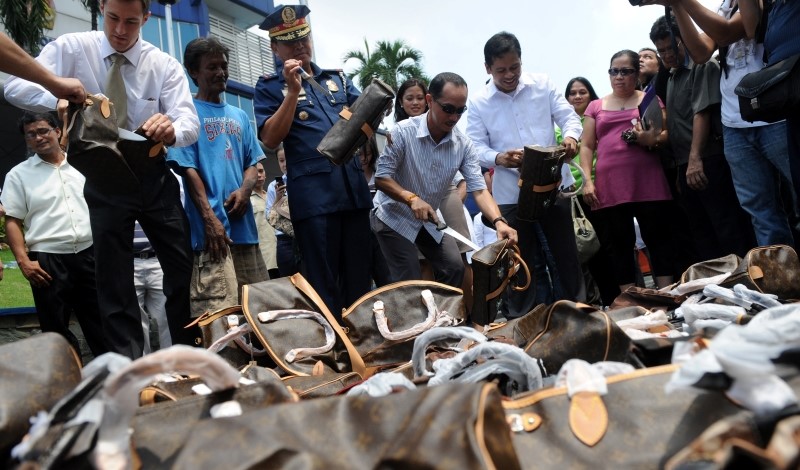
Scholars and policymakers explore solutions to the harms posed by counterfeit products.
Among consumers, there remains a common phrase: “You get what you pay for.” The counterfeit fashion industry, however, threatens this principle with what the Federal Bureau of Investigation refers to as the “crime of the 21st century.” Indeed, the international counterfeit goods industry is double the size of the global illegal drug market, with imitation products receiving highly visible praise on social media platforms.
How do some U.S. retailers legally sell products that closely resemble more expensive goods? One reason is that the United States takes a more relaxed approach to intellectual property (IP) protection for contemporary fashion than most European nations, allowing some retailers to offer knockoff goods that are not technically counterfeit.
Knockoffs do not claim to be the imitated product and do not intend to deceive individuals as they typically lack the original product’s branding. The brand Lululemon even hosted a pop-up in 2023 where consumers could trade knockoffs for a free pair of $98 leggings.
In the United States, knockoff goods are legal and occur naturally in response to fashion trends. In contrast, counterfeits are “substantially indistinguishable” from an original, often higher quality in design, and intended to deceive consumers by exploiting the original designer.
The United States differs from other countries in its enforcement against counterfeits. For instance, European countries such as Italy and France criminalize both the purchase and sale of counterfeit goods. In April 2024, before the Paris Olympics, French police officers closed 11 stores selling 63,000 items of clothing, shoes, and leather goods and arrested ten defendants. While anti-counterfeit police operations remain criticized for exacerbating impoverished situations, large events, including past Olympic events, contributed to a $1.83 billion loss in annual sales between 2018 and 2021.
In contrast, the United States imposes no criminal liability for the purchase of counterfeit goods under federal or state law, and legislative reform efforts remain stalled. For example, a bill to criminalize the purchase of counterfeit goods from former New York City Councilwoman Margaret Chin—who represented the neighborhood inclusive of Canal Street—remains unpassed.
Canal Street in New York City, referred to as “the heart of counterfeit goods,” stands less than half a mile away from the Criminal Division of the United States Attorney’s Office for the Southern District of New York. In under an hour, a government prosecutor could walk from their desk to purchase a counterfeit designer handbag without violating any New York state or federal laws.
According to the U.S. Customs and Border Protection, the agency seized counterfeit goods valued at over $2.7 billion in 2023. About half of the products seized were handbags, wallets, wearable apparel and accessories.
Counterfeit goods do not only harm large brands. Counterfeit goods’ profits partially funded the 1993 World Trade Center attack and the 2004 train bombings in Madrid. Likewise, profits from counterfeit items sold in New York are linked to terrorist organizations including Hamas, Hezbollah, and Al-Qaeda.
This week’s Saturday Seminar focuses on regulatory reforms across the globe intended to minimize harm from the sale of counterfeit goods.
In a report jointly prepared by the Organisation for Economic Co-operation and Development (OECD) and the European Union Intellectual Property Office, the OECD examines top destination economies of counterfeit products. The organization finds that nations with good-quality trade infrastructure facilitate counterfeit and other legal imports to the same extent, especially when low IP governance standards are present. The report emphasizes a strong need for awareness campaigns, especially as young people prove more likely to purchase counterfeits. Multiple factors, including governance, technological development, and education, impact a nation’s propensity to import counterfeit goods. Because factors that increase abilities to import counterfeit goods also benefit legal trade, leaders must balance misuse and beneficial trade in their governance.Economic models provide insight into how to maximize social welfare by decreasing sales of counterfeit products, Marta Biancardi and Giovanni Villani of Italy’s University of Bari, and Andrea Di Liddo of Italy’s University of Foggia argue in their article in Computational Economics. Biancardi and her coauthors explain that governments can deter counterfeiters through monitoring, sanctions, and fines, but the cost of these efforts should not outweigh their benefits. The Biancardi team found that there is a range in which government-imposed penalties should fall that ensures maximum deterrent effect while also maintaining positive social welfare. The Biancardi team further demonstrates that governments have more leeway to take action against counterfeiters when the counterfeiter must put more money into producing their goods.In an article in the World Trademark Review, Danny Grajales Pérez-y-Soto of the International Chamber of Commerce discusses various regulatory reforms to help prevent counterfeiting and piracy. Grajales recommends the development of guidelines and standards for third-party accreditation systems that monitor private companies. For the shipping industry, Grajales suggests implementing cargo reporting requirements and monitoring systems to flag suspected shipments of counterfeit goods. Grajales also discusses free trade zones and how the lack of regulation makes these zones ideal for the trade of counterfeits. To remedy this, Grajales argues that a balancing of trade facilitation and control needs to be met by enhancing customs authorities’ enforcement capabilities and requiring detailed digital recordkeeping.In an Office of the United States Trade Representative (USTR) report, the USTR analyzes positive regulatory developments in anti-counterfeiting, as well as areas where further regulation is required. Some positive developments are increased transparency for IP rights holders and the adoption of new technologies, including AI and text and image screening. The USTR also suggested tools for governments, including data sharing for border enforcement to interdict small consignment shipments, and reaching owners of counterfeit markets or counterfeit goods facilities through asset forfeiture. Especially with the rise of social media and e-commerce, the USTR raises concerns about lacking deterrent penalties for repeat offenders. Even when engagement between counterfeiters and IP rights holders increase, resources for anti-counterfeiting efforts remain insufficient.In an article in the Texas A&M Journal of Property Law, Francesca Gross of the American Federation of Government Employees discusses the anti-counterfeiting mechanisms of the United States, Italy, and France as model regimes for Asian countries. Gross argues that the U.S.’s Lanham Act and the Trademark Counterfeiting Act of 1984 create a trademark-owner friendly atmosphere through a broad definition of infringement and civil and criminal sanctions against violators. Gross explains that Italy and France are even more protective against counterfeiting, as they impose penalties on counterfeiters and consumers of counterfeit goods. Although Gross praises these regimes, she also notes the importance of education for consumers in identifying counterfeit goods to better protect themselves.Knockoffs of fashion trends are beneficial, but counterfeits harm the fashion industry and society, argues recent graduate of Saint Louis University School of Law Miranda Nolan in a note in the Saint Louis University Law Journal. Nolan warns that selling counterfeit goods creates unfair competition for legitimate products, increases unemployment, and exacerbates human trafficking and child labor issues. Current U.S. criminal and civil laws prohibiting the sale of counterfeit goods protect only a small percentage of designs from harmful forms of copying, Nolan explains. Nolan rebuts assertions that counterfeit fashion benefits the copied brand, pointing out that partnerships between high-end designers and affordable stores promote accessibility to fashion without perpetuating harmful consequences of counterfeits.
The Saturday Seminar is a weekly feature that aims to put into written form the kind of content that would be conveyed in a live seminar involving regulatory experts. Each week, The Regulatory Review publishes a brief overview of a selected regulatory topic and then distills recent research and scholarly writing on that topic.
