


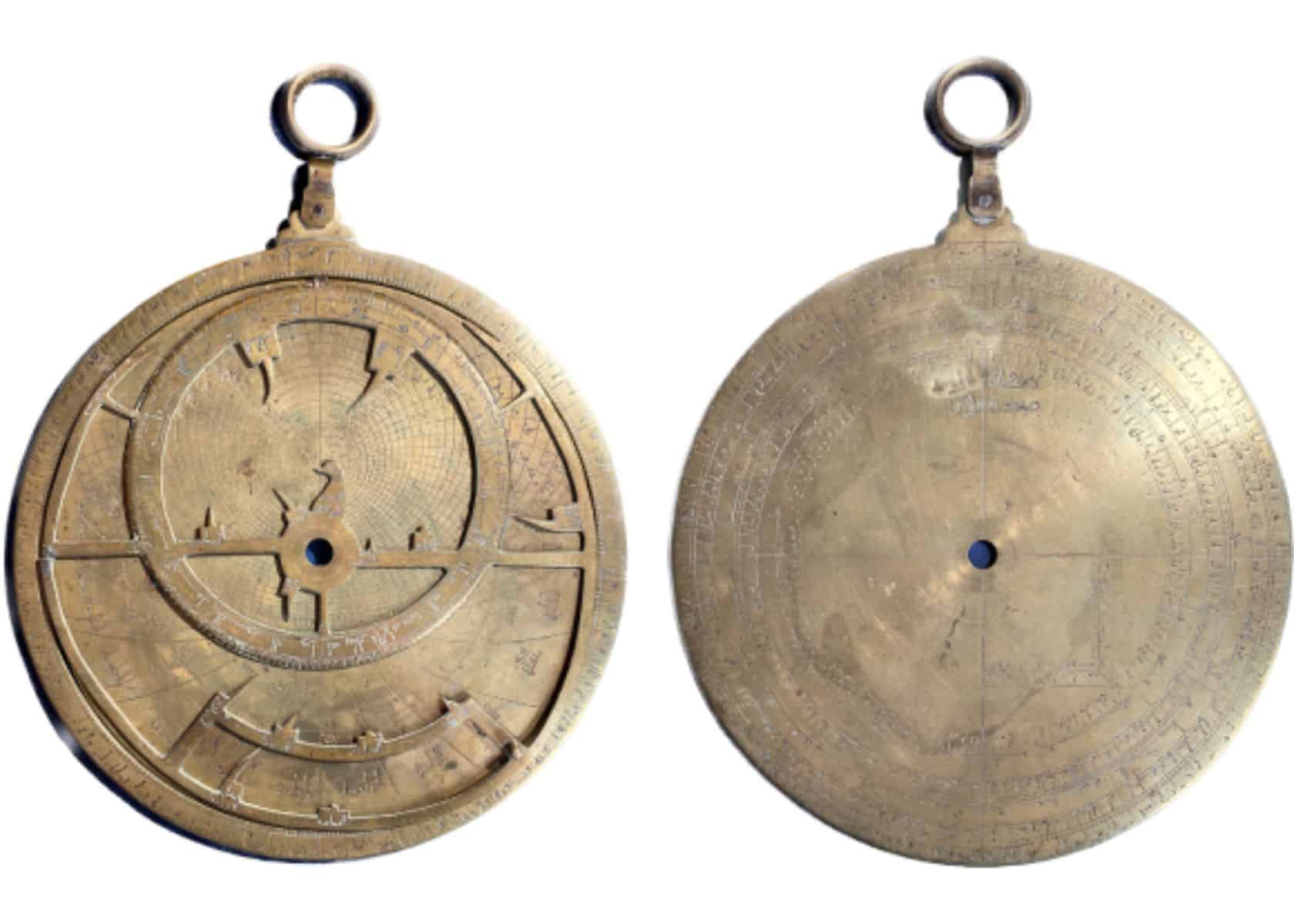
A 17th-century brass astrolabe sold for more than 2 million pounds ($2.75 million) at a Sotheby’s auction in London, setting a world record for any astronomical instrument from the Islamic world.
The sale surpassed the previous record held by an Ottoman astrolabe made for Sultan Bayezid II, a smaller piece that sold for just under 1 million pounds ($1.3 million) in 2014.
The instrument, described by Sotheby’s as perhaps the largest of its kind anywhere, had never been publicly displayed before appearing at the auction house’s London galleries.
Ancient Greece shaped a 2,000-year-old science
The history of the astrolabe stretches back far before its peak in the Islamic world. O. Neugebauer, a historian of mathematics and astronomy at Brown University, traced the instrument’s origins in a 1949 study published in the journal Isis.
Neugebauer showed that Ptolemy, the Greek-Egyptian mathematician working around 150 AD, already knew of the device. Ptolemy referred to it in his work, the Planisphaerium, as the horoscopic instrument, a term that predates the word astrolabe and rules out any later addition to the text.
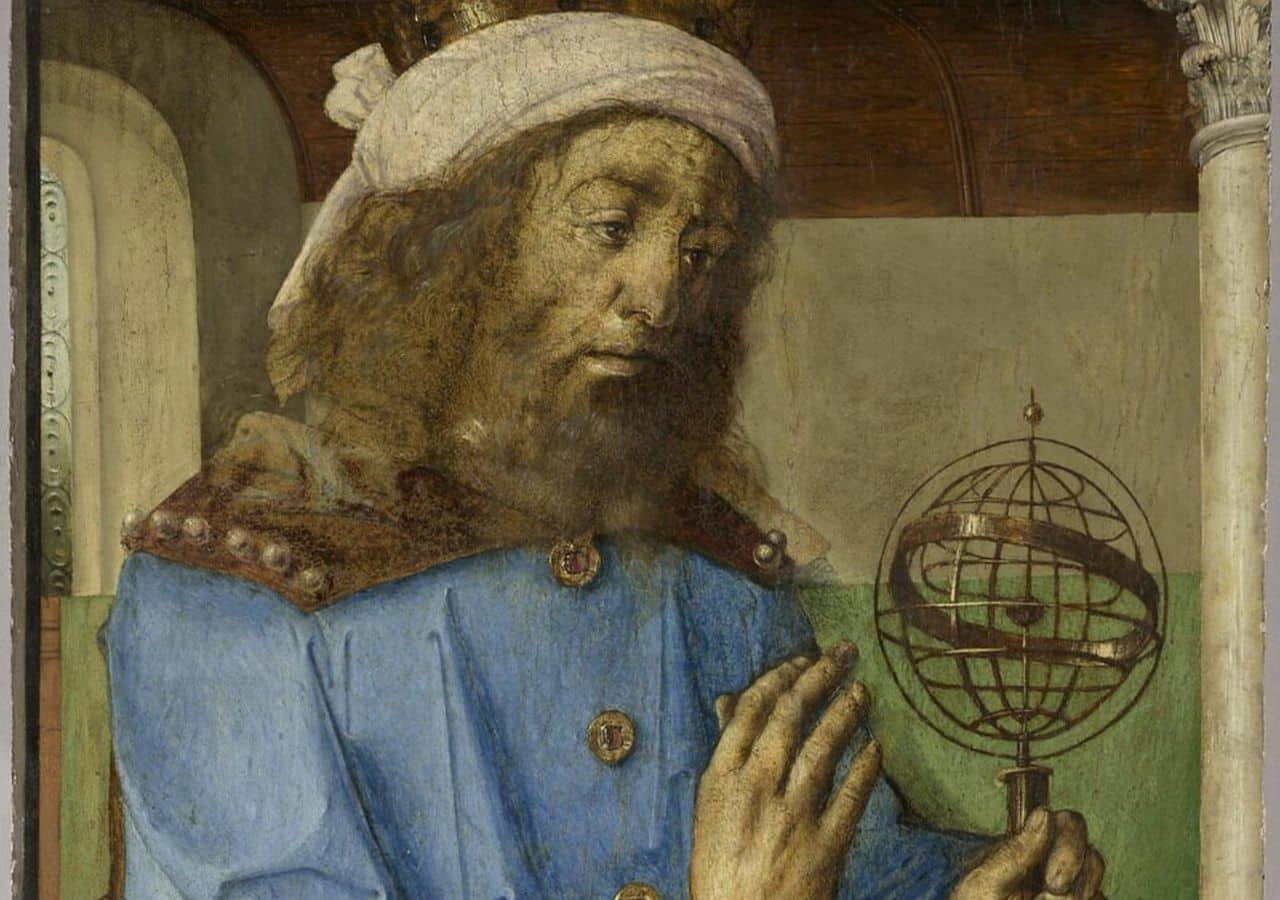
Neugebauer also argued that the theoretical foundation of the astrolabe, a geometric technique called stereographic projection, was likely known to the Greek astronomer Hipparchus as far back as 150 BCE.
Synesius, a scholar writing around 400 AD and a pupil of the mathematician Hypatia, recorded that Hipparchus was the first to study the unfolding of a spherical surface, which is the core principle that the astrolabe depends on.
Theon of Alexandria, working around 375 AD, later wrote a dedicated treatise on the plane astrolabe. That work was preserved through the writings of the Syriac scholar Severus Sebokht before 660 AD.
How the spider disc maps the celestial sphere
The device works by projecting the celestial sphere from its South Pole onto a flat surface. A rotating disc called the spider, named for its web-like network of star pointers, carries the 12 divisions of the zodiac and moves around the center of the instrument.
Below it sits a fixed plate engraved with horizon lines, altitude circles, and hour curves calculated for a specific geographical latitude. Together, these parts allow a user to determine the time, track stars, and solve a range of astronomical problems.
A rare 17th-century astrolabe, once owned by Jaipur royalty, is going up for auction in 🇬🇧London.
– It worked like an ancient “SUPERCOMPUTER” used to track stars, time, direction,& even astrology.
– Sotheby’s expects it to sell for £1.5–2.5 million. pic.twitter.com/187i12nGPh— Info Room (@InfoR00M) April 26, 2026
By the 8th century, knowledge of the astrolabe had spread across the Islamic world. Production centers grew in Iraq, Iran, North Africa, and al-Andalus, in present-day Spain. By the early 17th century, Lahore, now part of Pakistan, had become a leading hub of production within the Mughal world.
The Lahore astrolabe that rewrote auction history
Two brothers, Qa’im Muhammad and Muhammad Muqim, built the sold piece in Lahore for a Mughal nobleman. They belonged to the Lahore School, one of the most respected astrolabe-making traditions of the era.

The craft stayed within a single family and was passed down through generations. Only two astrolabes are known to have been jointly made by the brothers. The second, a much smaller piece, is held at a museum in Iraq.
The instrument was commissioned by Aqa Afzal, a nobleman who governed Lahore at the time. Originally from Isfahan in Iran, he served under Mughal emperors Jahangir and Shah Jahan in senior roles. Its large size and fine detail reflect his rank. The piece also points to the wider interest that Mughal rulers and courtiers held in astronomy and astrology during this period.
Technical mastery that defined the Lahore school’s legacy
Benedict Carter, head of Islamic and Indian Art at Sotheby’s, said the Lahore School was at its most refined when this piece was produced.
He noted it brought together technical accuracy, practical function, and artistic quality in a way that set it apart from older instruments from parts of the Middle East, which were often built for function alone.
The instrument stands about 46 centimeters (18.1 inches) tall, measures nearly 30 centimeters (11.8 inches) in diameter, and weighs 8.2 kilograms (18.1 pounds), making it nearly four times the size of a typical 17th-century Indian astrolabe.
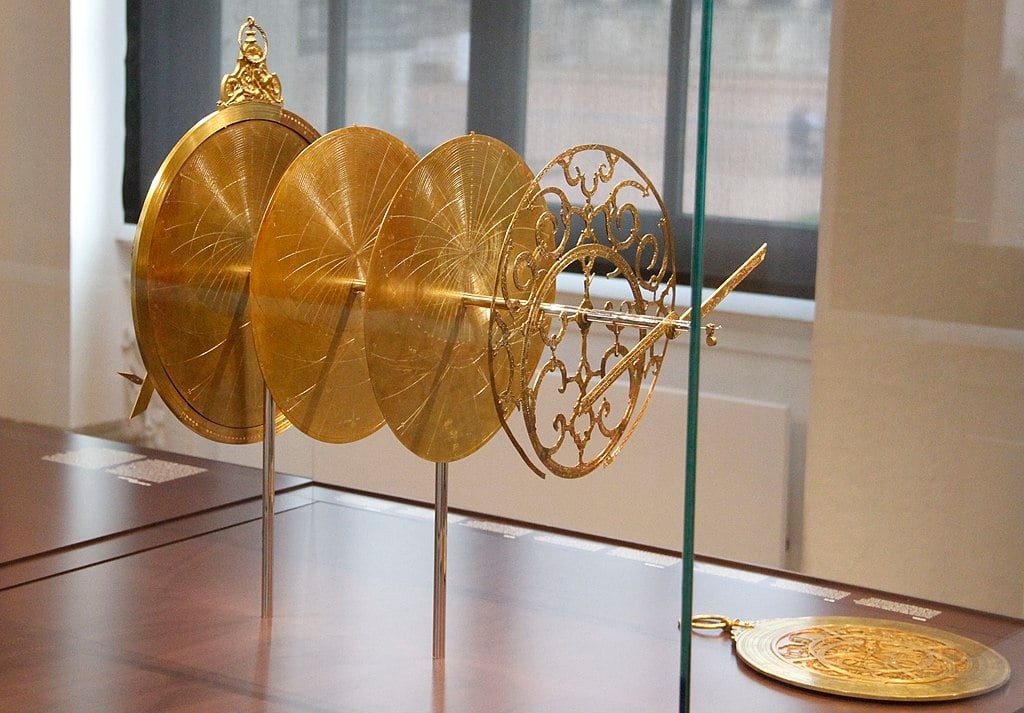
Sotheby’s reported it holds 94 cities, each recorded with its longitude and latitude, along with 38 star pointers joined by detailed floral designs, five precision-calibrated plates, and degree markings that break down to one-third of a degree.
Carter also noted that the star pointers carry labels in Persian alongside Sanskrit equivalents written in the Devanagari script, reflecting a cross-cultural dimension to the piece.
From Jaipur’s royal collection to a London sale
The instrument once belonged to the royal collection of Maharaja Sawai Man Singh II of Jaipur. After his death, it passed to his wife, Maharani Gayatri Devi, before moving into a private collection. Sotheby’s had said before the auction that its royal history and pristine condition were expected to attract interest from museums and collectors.
Dr. Federica Gigante of the Oxford Centre for History of Science, Medicine and Technology compared astrolabes to modern smartphones, noting they could calculate sunrise and sunset times, measure the height of buildings or the depth of wells, and cast horoscopes when paired with an almanac.
She described them as two-dimensional representations of a three-dimensional universe. Gigante added that this particular piece is remarkably accurate, capable of giving the exact degree of altitude of a celestial body, and that the only comparable instrument is likely one built for Abbas II of Persia.
