


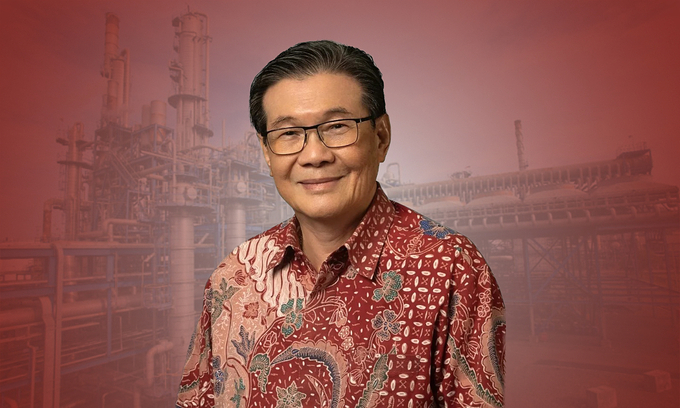
The 82-year-old energy tycoon is now worth $14.3 billion, compared to $39.5 billion at the end of last year, according to Forbes.
The chairman of Barito Pacific Group has lost the title of the richest man in Southeast Asia to Vietnamese billionaire Pham Nhat Vuong, who is now worth $33.7 billion.
He is also no longer the richest man in Indonesia and ranks third behind coal tycoon Low Tuck Kwong ($16.5 billion) and banking tycoon R. Budi Hartono ($14.4 billion).
Prajogo Pangestu, chairman of Barito Pacific Group. Graphic designed by VnExpress/Dat Nguyen. Photos courtesy of Bakti Barito, Barito Pacific Group
Barito Pacific Group, one of Indonesia’s largest diversified resources and energy companies, has seen its share plunge 57% year-to-date.
Shares of other companies linked to Pangestu have also plummeted. Barito Renewables Energy and Petrosea have each dropped 65%, while coal mining firm Petrindo Jaya Kreasi fell 73% and Chandra Asri Pacific decreased 76%.
A major catalyst for the heavy selling of these companies’ shares came in May when MSCI, an American financial services company that analyzes global stock data, removed several Indonesian firms from its Global Standard Index after raising concerns about highly concentrated ownership and shareholder transparency.
Among those removed were Barito Renewables Energy, Chandra Asri Pacific and Petrindo Jaya Kreasi.
Hasan Fawzi, head of capital market supervision at Indonesia’s Financial Services Authority, said the removals reflected the companies’ failure to meet MSCI’s evolving criteria, according to the Jakarta Globe.
He said the changes are part of Indonesia’s capital market reform agenda, which is intended to strengthen the market’s long-term credibility and transparency for global investors, even if it results in short-term pressure on share prices.
As Prajogo’s companies had become some of Indonesia’s largest market-cap stocks, they were affected by deteriorating sentiment toward Indonesian equities.
The foreign net outflows from Indonesian stocks were estimated at $3.9 billion in mid-June, according to the Financial Times. This has contributed to a slump in Indonesia’s benchmark stock index, which is the world’s worst-performing equity market so far this year.
“Indonesia has done a lot of good work over the years in establishing a hard-won belief and trust in key financial and policy institutions,” said Alan Siow, co-head of emerging market corporate debt at asset manager Ninety One.
“Unfortunately, this confidence is now fragile and fraying, and if lost may take a longer time to rebuild.”
Companies linked to Pangestu have announced share buyback plans after a market sell-off.
Listed companies associated with billionaire Prajogo Pangestu, including Barito Pacific, Barito Renewables, Chandra Asri Pacific, and Petrindo Jaya Kreasi, in February announced plans to repurchase shares worth up to $343 million.
The buyback, however, has not made significant improvement to the performance of the shares.
With a net worth of $14.3 billion, Pangestu now ranks lower in wealth compared to several other Southeast Asian billionaires.
Singapore’s top billionaire Jason Chang is now worth $23.3 billion. The wealthiest individual in the Philippines, Enrique Razon, owns $20.2 billion in assets. Thailand’s two richest men Sarath Ratanavadi and Dhanin Chearavanont are worth $16.8 billion and $15.9 billion, respectively.
