



(© sveta – stock.adobe.com)
In a nutshell
The richest 10% of people are responsible for up to 67% of global environmental damage—including most carbon emissions, biodiversity loss, and resource overuse—while the bottom 50% contribute almost nothing to these crises.
Changing the consumption habits of the wealthiest individuals could significantly reduce environmental harm. If the top 20% adopted more sustainable lifestyles similar to high-income Europeans, global ecological pressure could drop by as much as 36%.
Policies targeting high-end consumption, not across-the-board restrictions, may be the most effective and fair path forward, especially if focused on sectors like luxury travel, meat-heavy diets, and resource-intensive goods.
GRONINGEN, Netherlands — While you debate whether to take that vacation or buy organic groceries, someone just burned through your entire year’s worth of environmental impact in a single weekend getaway. New research reveals that the richest 10% of people aren’t just living large; they’re actively breaking the planet’s life support systems.
A new international study published in the journal Nature analyzed data from 168 countries and found that the global top 10% of consumers are responsible for up to 67% of planetary boundary breaches. This essentially means a tiny sliver of humanity is wrecking the environment for everyone else. The research examined six critical environmental areas: climate change, land use, biodiversity loss, and the nitrogen, phosphorus, and freshwater cycles that keep our ecosystems functioning.
The bottom 50% of the global population, nearly 4 billion people, contributes almost nothing to these environmental crises, while a privileged few live lifestyles so resource-intensive they’re literally breaking the planet. If that is the case, does everyone need to make sacrifices equally? Or should it be the responsibility of the ultra-rich whose consumption habits are the real problem?
How the Rich Are Breaking Planetary Boundaries
The study used what scientists call “planetary boundaries,” essentially speed limits for how much damage humans can do to Earth’s systems before triggering irreversible environmental collapse. These boundaries are the red tape we shouldn’t cross if we want to keep the planet habitable. The research team calculated how much of each boundary different income groups were responsible for breaching.
For climate change, the top 10% of consumers globally are responsible for 43% of all carbon emissions. For biodiversity loss, measured by something called mean species abundance loss, that same group accounts for a whopping 67% of the damage. Meanwhile, the poorest 10% of people contribute less than 5% to any environmental problem measured.
The breakdown by the top 1% versus everyone else is alarming. This ultra-elite group contributes 14% of global carbon emissions despite representing less than 1% of the population. Their per capita environmental footprint is 6 to 70 times larger than the bottom 50% of humanity.
What Ultra-Wealthy Consumption Actually Looks Like
The study examined different sectors of consumption and found that food, especially meat, is a major driver of environmental damage for all income groups, but wealthy consumers also have massive footprints from services like luxury travel, manufacturing of high-end goods, and energy-intensive lifestyles. The richest groups consume considerably more in almost all categories, leading to substantially greater environmental pressure.
The researchers also analyzed how consumption patterns differ across income levels. Wealthy groups had higher shares of animal-based food consumption, while poorer groups relied more on plant-based food. For carbon emissions and biodiversity loss, the wealthiest consumers showed high impacts from services and manufacturing products, whereas poorer groups’ consumption was mainly focused on daily necessities like food.
Solutions That Target the Biggest Polluters
To see if there are potential solutions to this problem, study authors ran six different scenarios examining what would happen if the world’s wealthiest consumers either reduced their consumption or made their lifestyles more environmentally efficient.
If the top 10% of consumers simply adopted consumption levels similar to the European average (still comfortable by any measure), global environmental pressure would decrease by 9-23% across different indicators. Expanding this to the top 20% of consumers would slash environmental damage by 14-36%.
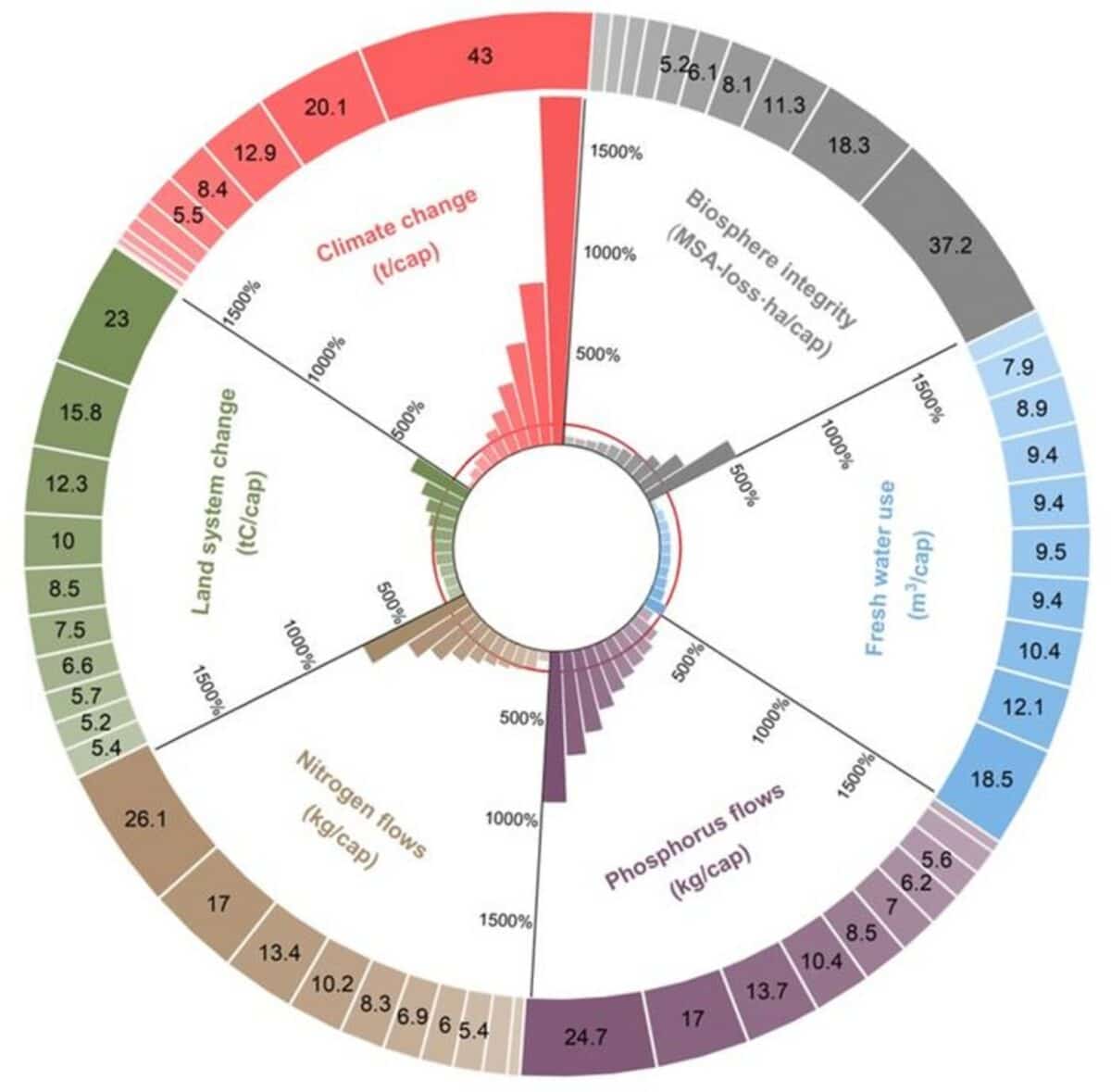
Focusing changes just on food and services sectors among high consumers could bring land-system change and biodiversity loss back within safe planetary boundaries. This suggests that targeted policies affecting the wealthy, rather than across-the-board restrictions hitting everyone, could have more positive impacts.
Crucially, these aren’t calls for the rich to live in poverty. The “reduced” consumption levels in the study scenarios still correspond to lifestyles equivalent to high-income European countries. The global 10th percentile consumption level, what researchers suggest as a target for the top 10%, equals about $27,000 per year, comparable to the European average in 2017. That’s hardly destitution.
Many of today’s wealthy nations and individuals have been contributing to environmental problems for decades or centuries, which this study doesn’t fully capture. The research does cover most environmental impacts, but it doesn’t include all possible planetary boundaries, such as chemical pollution.
Environmental messaging has traditionally been about collective responsibility and individual action. Holding the biggest spenders accountable could be far more effective and equitable than broad-based restrictions. After all, why should billions change their behavior for the environmental sins of the few?
Paper Summary
Methodology
Researchers analyzed consumption and environmental impact data from 168 countries, covering 98% of the global population through 201 different consumption groups. They used an environmentally extended multi-regional input-output (EE-MRIO) model to trace how spending in different sectors translates to environmental damage across global supply chains. The team examined six environmental indicators related to five planetary boundaries: carbon emissions (climate change), human appropriation of net primary productivity or HANPP (land-system change), nitrogen and phosphorus use (biogeochemical cycles), blue-water consumption (freshwater use), and mean species abundance loss (biosphere integrity). They classified consumers into global expenditure deciles to compare environmental footprints across income levels.
Results
The study found extreme inequality in environmental impacts. The global top 10% of consumers contributed 31-67% of planetary boundary breaches, while the top 20% accounted for 51-91%. The wealthiest 1% alone generated 14% of carbon emissions despite representing less than 1% of the population. Food consumption, especially animal products, was a major driver across all income groups, while wealthy consumers had additional large footprints from services, manufacturing, and transport. Six scenarios testing consumption reduction and efficiency improvements among high earners showed potential environmental pressure reductions of 25-53%, with some scenarios capable of bringing land-system change and biodiversity loss back within safe limits.
Limitations
The analysis focuses on 2017 data and annual impacts rather than cumulative historical responsibility for environmental damage. The study doesn’t include all potential planetary boundaries, such as chemical pollution, and uses a one-year timeframe that may not capture longer-term consumption patterns. The research also assumes equal distribution of government spending and investment across income groups, which may not reflect reality. Regional variations in consumption patterns and environmental impacts are acknowledged but not fully explored.
Funding and Disclosures
This research was supported by the National Natural Science Foundation of China, the Major Grant in National Social Sciences of China, the Taishan Scholar Youth Expert Program of Shandong Province, the Fundamental Research Funds for the Central Universities (Peking University), and the High-performance Computing Platform of Peking University. The authors declared no competing interests.
Publication Details
The study, “Keeping the global consumption within the planetary boundaries,” was authored by Tian, P., Zhong, H., Chen, X., Feng, K., Sun, L., Zhang, N., Shao, X., Liu, Y., & Hubacek, K. It was published in Nature (635, 625-630) on November 13, 2024.
