

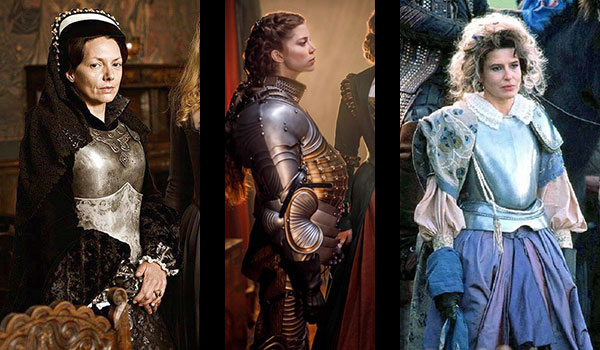
I’ve been noodling around on the idea of this post for three years (according to our Word Press history) because it’s such a common trope in frock flicks, and I wanted to put some good, solid research into it. But fuckit, because THIS:
The Spanish Princess, Season 2 (2020), comes along with FUCKING MATERNITY ARMOR for Catherine of Aragon. This is wrong on so many levels that I had to just dive into this post right ASA-the-fuck-P. I’ll include as much historical research as I can muster whilst being disgusted and outraged by the bullshit!
A Bit About Historical Armor
First, let’s start with a very basic overview of historical armor. I’m not an expert, but I’ve seen some stuff and apparently more stuff than some film productions. Many movie and TV shows focus on plate armor, which was most popularly used in European warfare from around the 14th through 16th centuries. Chain mail was used before this, but also during and after.
Essentially, plate armor is the type of protection made from solid pieces of metal that are shaped to fit parts of the body, such as a breastplate and arm and leg coverings.


Chain mail is the type of armor that’s made from rings of metal linked together to form a fabric-like garment, often a shirt.

There are also helmets, leather armor, layers of padded/quilted garments that are worn with metal armor, etc., etc. It’s a whole category of clothing unto itself, of course!

What any particular person in a battle wore for protection depended on the exact time period, geographic area, and, importantly, what they could afford. Consider that a metal helmet/chain mail shirt combo would be less expensive for a foot soldier than a full suit of armor that a knight or noblemen might afford.
What About Women on the Battlefield?
We’ve mentioned anachronistic feminism before and why it bugs us. We watch women in historical movies and TV shows to see something about the reality of women’s lives in times past, and the majority of those women were not soldiers or leading armies.

Now, women have been involved in battles and war forever, that is a historical fact! But because they were the exception, not the rule, they didn’t have specially made, custom outfits to do so. Even in the 21st century, or at least until 2012 according to Stars and Stripes, women in the U.S. Army wore “combat uniforms designed with the male body in mind.” So women in “girl armor” onscreen for a medieval or renaissance battle stretches credulity. We’re not reviewing Game of Thrones here, folks.

That said, there were women in the 14th through 16th centuries who participated in battles. Could they have worn armor? Maybe, but extremely doubtful it would look like what the movie and TV depictions might have it.
Here’s a pretty practical point via Tor.com:
“Let’s begin by stating the simple purpose of plate armor — to deflect blows from weaponry. Assuming that you are avoiding the blow of a sword, your armor should be designed so that the blade glances off your body, away from your chest. If your armor is breast-shaped, you are in fact increasing the likelihood that a blade blow will slide inward, toward the center of your chest, the very place you are trying to keep safe.”
That’s the most obvious reason why, historical or modern, plate armor shouldn’t be designed to highlight the boobs especially for a female form. Duh!

A Note on Mythological and Allegorical Imagery
If you’ve googled the topic, maybe you’ve found some genuine medieval and renaissance images of women wearing armor. Cool, huh? Must mean that’s what happened, there were totally women wearing full plate armor in battle in the 14th century ‘n stuff?

Yeah, no. What you’re probably seeing is mythological, allegorical, or legendary artwork. Meaning, it’s still fantasy, but it’s just ye olde-timey fantasy.

For example, the writings of Christine de Pizan (1364–1430) often include artwork depicting the Amazons from Greek and Roman mythology. Also, the Italian writer Boccaccio complied a book of stories about legendary female figures, and the French illustrations for it show lots of armor-clad women, but they’re fictional or from times more ancient than the book’s author or illustrator.


Setting the mythical aside, let’s examine some more realistic historical scenarios.
Women in Battle – Probably Without Armor
Plenty of female rulers, without help of men, sent their people into war, but we can’t tell if they wore armor to do so. It’s not always clear if these queens and noblewomen were literally on the battlefield, leading the charge. There’s a dearth of contemporary pictorial or written evidence that they were wielding swords ‘n stuff. Legends grew up about these “warrior women” after their lifetimes, and that seems to be what movies and TV shows rely upon instead of looking at primary sources.

Empress Matilda, also called Maude, (1102–1167) is sometimes considered England’s first ruling queen, although her reign was disputed. As the daughter of King Henry I, she tried to take the kingdom by force during a succession crisis which kicked off a civil war. There isn’t much to suggest she wore armor into battle, and this is a bit too early for full plate armor anyway.

She shows up The Pillars of the Earth (2010), a fictional story set in the 12th century, and does wear some chain mail. That part seems reasonable if you buy that she’s charging around with her army.

But the gold lame is just ludicrous!

If we didn’t have maternity armor to discuss, that would be the most egregious thing in this post! OK, then.
Another medieval “warrior” queen is Isabella of France (1295–1358) who led an army to depose her husband, Edward II of England, in 1326, and put their son on the throne as Edward III. She was super in-charge, especially compared to her kinda wishy-washy king, but I can’t find contemporary descriptions of her wearing armor.
The Chronicles of Jean Froissart shows Isabella at the Siege of Bristol — she’s the one wearing a crown. Jean Froissart (1337-1410) was a historian at the court of Edward III, so while he may not have seen this battle, he was writing his chronicle for the son and daughter of the subject. These illuminations are as close to contemporary as I could find.

This history was popular and other versions were created in later years. The French historian and solidier Jean de Wavrin (c. 1400–1474) wrote his Chroniques d’Angleterre around 1445. Nearly 120 years after the event, Isabella is depicted in armor over a gown, beside her lover / general Roger Mortimer, Earl of March. Questionable clothing, I say!

Isabella doesn’t show up too often onscreen. She’s “Princess Isabelle” in Braveheart (1995), played by Sophie Marceau, but that’s for a fictional romance, as she would have been 9-years-old during the whole William Wallace action. The miniseries World Without End (2012), the sequel to Pillars of the Earth, includes Queen Isabella at battle, flanked by her son Edward and her lover Roger Mortimer.

Wearing a bit of chain mail is probably the most she’d have done in period, IMO, so this looks fine.
Moving forward in time and towards more heavy-armor eras, how about Shakespeare’s she-wolf of the history plays, Margaret of Anjou? She was a key antagonist in the Wars of the Roses and “led” an army into battle, specifically the Second Battle of St. Albans on February, 17, 1461, and the Battle of Tewkesbury on May 4, 1471. According to contemporary accounts, Margaret stayed at a nearby abbey during the Tewkesbury fighting, and there’s nothing to indicate she was on the field at St. Albans either. So, despite Shakespeare’s characterization, I think it’s unlikely she’d be wearing armor.
In The Hollow Crown, Queen Margaret starts out in medieval woman’s garb, but when the war starts up, she dons full armor.


It looks great on TV, makes all of Shakespeare’s points, and Sophie Okonedo is awesome in the part, but the costume is not all that historically accurate.
Philippa fucking Gregory had her take on Margaret of Anjou in The White Queen (2013), where likewise, she wears women’s clothing but puts on armor to fight. Here, it’s leather armor. No idea why because the noblemen are in metal plate armor and chain mail. I guess this is the TV show’s version of “girl armor,” ugh.


One seriously bad-ass historical woman was Caterina Sforza. She was nicknamed La Tigre — The Tigress — for her defense of Forlì in 1499, as well as for her occupation of Castel Sant’Angelo in 1484. This Italian noblewoman took charge of multiple dangerous situations over the course of her lifetime. Her primary tactics were to occupy her domain, outlast a siege, and execute those who opposed her afterwards.

All the portraits of her from her lifetime are in women’s clothes or allegorically still feminine, and I can’t find anything about her in armor. But that hasn’t stopped TV! Both Showtime’s The Borgias (2011–2013) and the Borgia: Faith and Fear (2011–2014) series included some of Caterina Sforza’s story, with her in armor. She played a bigger part in the Showtime series and was only shown in armor a few times. In the other series, she’s just in two episodes when Cesare Borgia finally captures her.


Now for some reason, frock flick makers decided to throw armor on even more women rulers simply because, IDK, they were strong women? Ugh, it’s a trope! These next two are pix that inspired my original idea for this post since they’re such head-scratchers.
Of historical characters who get the short shrift onscreen, Mary Tudor, Mary I of England (1516–1558), is right up there. The eldest legitimate child of Henry VIII had a complicated, bitter life. She didn’t gain the throne until she was 37, she only ruled for 5 years, she had a terrible long-distance marriage and a bunch of false pregnancies, and she died.

Yet here we go in The Virgin Queen (2006), adding costume nonsense to Mary’s already sad story. From what I remember of the scene, Mary wears this breastplate while accusing Elizabeth of conspiring against her. She’s not even doing the horseback-leading-the-troops thing. Because it didn’t happen, and while she may well have argued with Elizabeth, it’d have been silly to put on armor to do so!

It’s boob armor too. SMH.
Now, let’s take a look at Mary of Guise. She was the mother of Mary Queen of Scots and served as regent of Scotland while MQoS was a child, having been sent to France for safety. Because Scotland was kind of a sketchy place for a baby girl Catholic queen, especially once the Protestant Reformation took hold. Mary of Guise was intelligent and determined, and she did have French troops at her disposal to fend off the Protestant Scots lords. She was even described as having “hart of a man of warre” by Nicholas Throckmorton, the English ambassador in France. But none of this is proof that she led an army and wore plate armor.

Yet in Elizabeth (1998), there’s a whole stupid, historically inaccurate side-plot about Mary of Guise, and to make matters worse, she’s in armor.

Yeah, nothing about that costume is particularly fabulous for the 1550s. sad trombone
But wait, her daughter gets some unnecessary onscreen armor too! Mary Queen of Scots had a tumultuous reign once she returned to Scotland as an adult, and it ended in an attempted battle. Most screen versions show her final marriage as the result of some romance with the rebel lord Bothwell, who conspired to kill her husband Darnley. The truth is far more likely that she was abducted, raped, and coerced by Bothwell into his rebellion.

She accompanied the army Bothwell raised at Carberry Hill on June 15, 1576, but because she had been abducted, she was wearing borrowed clothes, according to Antonia Fraser’s seminal biography Mary Queen of Scots (1969): “a short red petticoat, a muffler, a velvet hat, and sleeves tied with bows, such as the women of Edinburgh wore.” No mention of armor, it’s just not thing!
But first the ’70s biopic puts her in a breastplate, and the most recent flick has its own shitty version of the costume.


Stop the madness!

Women in Battle – Dressed as Men
The historical record has a lots of examples of women who wore men’s clothing and participated in battles. There were, of course, a wide range of reasons why a woman would do this — from wanting adventure to believing in a religious or political cause to being transgendered and identifying as male and many combinations of reasons that we’ll never know.
Appearance-wise, these women’s armor would look identical to men’s. Either no-one thought they were women in the heat of battle, or if bystanders could tell or knew the soldier was a woman, the description would be of a “woman in man’s clothing” or a masculine female. So if these folks are portrayed onscreen, their costumes should just be typical male historical armor.

Mulan (2020) is one such story of a woman disguising herself as a man to go to war. This is a legendary tale, but you can see in the live-action movie how the main character is trying to blend in and not appear female.
Not every woman wore men’s clothes in battle to hide her identity though. In “Women in the Military: Scholastic Arguments and Medieval Images of Female Warriors” by James M. Blythe, a Byzantine historian Nicetas Choniates (1150–1213) is quoted as describing female Crusaders thusly:
“Females were numbered among them, riding horseback in the manner of men, not on coverlets sidesaddle but unashamedly astride, and bearing lances and weapons as men do; dressed in masculine garb, they conveyed a wholly martial appearance, more mannish than the Amazons.”
There, the observers know the fighters are women, but also see that they’re dressed in men’s clothes and make a point about their masculine appearance. But the Crusades are a bit before plate armor was popular.

Of course, everyone’s favorite woman in battle dressed as a man must be Joan of Arc (1412–1431). Costume-wise, she should be wearing male armor because that’s what she could scrounge up. It’s widely reported that she borrowed men’s clothing and armor the whole time she was on her mission to meet King Charles VII of France and lead his army. And cross-dressing was added to the charges against her that she was executed for.
The only contemporary image of Joan of Arc is a doodle dated May 10, 1429, and drawn by Clément de Fauquembergue, but he never actually saw her. He shows Joan carrying a sword and not wearing obvious armor.

Written and illustrated around 1484, Les Vigiles de Charles VII shows many episodes from Joan of Arc’s life, and in them, she’s wearing some or full armor.


How do films and TV measure up? Not too bad, actually! Joan gets standard male armor and she’s not particularly feminized in the screen adaptions I’ve seen. I do think her armor should look more borrowed and less well-fitted and shiny, if I were to nitpick.

The ’40s film was Bergman’s passion project and had a decent budget. That was long before “gritty realism” though.


The ’90s film got more gritty in terms of Joan’s costume.

Joan of Arc is briefly part of Shakespeare’s Wars of the Roses cycle, and the costuming is fine.

Hey, why not! I love Ms. Of Arc played by my favorite Go-Go. Her costume looks like a knit sweater topped by a cardboard collar, which it probably is.
Women in Battle – Wearing Armor as Women
This is the category that frock flicks love to portray but seems most elusive in history: self-identified women who participated in battle or led an army while wearing some form of armor.

The most obvious example is Queen Elizabeth I. While she didn’t join a battle, she did wear some armor to address her troops before they fought the Spanish Armada. In The Life of Elizabeth I by Alison Weir (1998), Elizabeth is described arriving at the field of Tilbury on August 8, 1588:
“The Queen appeared in the guise of ‘some Amazonian empress’ in a white velvet dress with a shining silver cuirass, and preceded by a page carrying her silver helmet on a white cushion and the Earl of Ormonde bearing the sword of state.”
Note that the cuirass (or breastplate) is the only item of armor she’s wearing, she’s wearing it with a dress, and the helmet and sword are carried by others. The next morning, Elizabeth gave her famous speech with the line “I have the body of a weak and feeble woman, but I have the heart and stomach of a king.” That day, she’s described as:
“‘most bravely mounted on a most stately steed,’ and dressed as ‘an armed Pallas’ with her silver breastplate and a small silver and gold leader’s truncheon in her hand”
“Pallas” refers to Athena, the Greek goddess associated with both wisdom and war. This entire episode was stage-managed by her courtier Robert Dudley, Earl of Leicester, for maximum pageantry and spectacle.
This Tilbury speech moment is often included in movies and TV shows about QEI, but with varying degrees of historical accuracy. From best to worst costume, in my estimation are:


Dame Helen’s look gets my top marks because she has a shiny silver breastplate that looks the same shape as a man’s would. No “girl armor” here. This is worn over a pale-ish gown, with a typical ruff and hat of the period.


Released the same year by the BBC (and thus a bit lower budget than HBO’s Elizabeth), The Virgin Queen has the most complete version of the Tilbury speech. The queen wears a correct white gown and silver breastplate, but I give it a tiny demerit because in the large images, it kind of looks like there’s a shadow of bust cup shaping to that cuirass that’s slightly disguised by the red sash. The armored gloves are an unnecessary touch.


Probably the first depiction of the Tilbury speech on film is shortened, but the queen in Fire Over England is wearing a standard masculine breastplate over her gown with a 1580s ruff, hat, and gloves. I like that she’s shown wearing the gown without the breastplate in another scene, and it really looks like she just borrowed the thing for the speech.


As much as it pains me to admit this, my beloved Elizabeth R doesn’t have the most historically accurate costume for the Tilbury speech. But at least it’s by omission! The queen merely wears an armored gorget, not a breastplate, though she does carry a shiny stick that’s kind of like the “gold leader’s truncheon.” Her outfit is a perfectly lovely 1580s wheel-farthingale outfit, but it’s not white either.


Now here’s your full-on fantasy version of Queen Elizabeth at Tilbury! Oh it’s beautiful cinema, that’s for sure. But Cate Blanchett seems to be channeling her Lord of the Rings and Robin Hood roles with that long, romantic hairstyle. Plus, she’s wearing a full head-to-toe suit of armor, which was just not QEI’s thing. Sorry, no!

Catherine of Aragon in Maternity Armor?
I guess the folks behind The Spanish Princess didn’t dig any farther than Wikipedia because they bought into a myth about Catherine riding into battle, pregnant and in full armor. Thus, this monstrosity:

MY EYES!!!!!! Not only does she wear this nonsense, it’s supposed to stir up the troops — instead of horrifying them, because why would you want your pregnant queen anywhere near the battlefield?
Co-showrunner Matthew Graham says in Elle: “We write her a real Henry V at Agincourt.” eyeroll Sure, Henry V was a great military leader, but he left the kingdom with a baby son and feuding uncles that led to the Wars of the Roses because the succession to the crown was disputed! Catherine and especially Henry VIII knew that the Tudor dynasty was fragile, and Henry wanted sons to secure his legacy.

OK, is there any truth about Catherine of Aragon going to war? Well, Catherine was appointed Governor of the Realm and Captain General in 1513 by Henry VIII while he was off fighting in France. And during that time, England dealt with an attempted Scottish invasion. Catherine was hands-on in the sense that she worked directly with the Privy Council and ordered several key preparations for the battle. Here’s where some armor fiction may have come from.
A blog post from the UK’s National Archives explains the situation and cites several entries in the Chamber Book Payments from early September 1513. Specifically: “Item, to Owen Holand upon a warrant for the conveying of 1500 almain rivets northward.” This is from Queen Catherine and she’s ordering up a bunch of armor, called “almain rivets,” plus weaponry from the Tower of London. That month, she attempted to accompany this shipment north, towards the Scottish border, as these documents in the National Archives describe.
So she went to the battle WITH armor. Not WEARING it.
She was taking 1,500 pieces of armor TO THE BATTLE, for, y’know, the soldiers.

A photo of the warrant she signed on September 8 “authorising the delivery of Tower armour to her servant Owen Holand for her journey to Warwick” is shown on that blog page.
British History Online has an archive of letters from Henry VIII’s reign, to / from / directly concerning the King, and you can read the early September 1513 ones here. Catherine writes to Wolsey on September 2, from Richmond, presumably Richmond Palace, which today would be in the greater London area. On the 8th, still in Richmond, she writes to arrange for the royal standards, banners, trumpet banners, etc.
Something about the timeline of those letters doesn’t add up because September 9th is the Battle of Flodden where the English triumph and the Scots King James IV is killed. Catherine ordered a bunch of armor, weapons, and royal banners just a few days before the battle!
Now, it’s about 350 miles between Richmond-Upon-Thames and Flodden in Scotland (and over 250 miles between Warwick and Flodden, Warwick being where Catherine was delivering armor specifically), and let’s just say they didn’t have Amazon Prime back in 1513. Hauling thousands of pieces of battle gear across country in less than 8 days would have been a heroic feat, not to mention getting a queen and her retinue there. Sounds like Catherine had a good idea but poor execution, and I highly doubt she had time for stirring speeches either. And, of course, nowhere is it documented that she wore armor.
Finally, on September 16, 1513, Catherine writes to Henry, telling him of the Battle of Flodden, and she opens the letter with:
“My Lord Howard hath sent me a letter open to your Grace, within one of mine, by the which you shall see at length the great Victory that our Lord hath sent your subjects in your absence”
She refers to Thomas Howard, Earl of Surrey, who led the battle for the English, and she’s retelling Howard’s story of the battle to Henry. Because she wasn’t there. She’s got it second-hand. So let’s put this idea of Catherine of Aragon leading the battle to rest, m’kay? There just isn’t sufficient historical documentation for it.
Besides, look at the crazy armor Henry VIII did keep — if maternity armor was around, surely someone would have kept that oddity too?!?

Lest you think I’ve missed a feminine armor oddity, nope, that “armor dress” floating around Google and Pinterest is a historical fake

This was a 2003 project by two designers, Esther Geremus and Birgit Hutter, on display at the Styrian Armoury, and the “armor” is made of plastic!
Will you be watching The Spanish Princess for that maternity armor?
