Get exclusive access to the world’s most expensive, rare, and luxurious experiences.
From billionaire lifestyles to once-in-a-lifetime discoveries — delivered directly to you.
The other day, Samo Burja noted that while Europe has a lower per capita GDP than America, Japan’s is even lower:
Now, Samo makes what I think is a major mistake here — using GDP at market exchange rates rather than at purchasing power parity. If only imports mattered for living standards, we could use market exchange rate GDP here, since that reflects how many imports you can afford. But because most of what people buy — rent, health care, transportation, and so on — is produced domestically, you really need to account for those prices when you measure living standards. If people can get cheaper rent, health care, and transportation, they are richer. This is what PPP tries to do. And when we look at the PPP numbers for the U.S., Austria, and Japan, they’re a lot closer together than the numbers Samo quoted:
In fact, Japanese people aren’t actually less than half as rich as Americans. They’re about two-thirds as rich.
But there are a number of people who think even that difference is greatly exaggerated. They point out that Japan has a very safe society with high life expectancy and functional public transit, while America is a comparatively dangerous society with much lower life expectancy and poor public transit. Here are a few examples of replies I got when I pointed out that Japanese living standards are significantly lower than Americans’:
To answer East Bay Ray’s question, I have lived in Japan for four years, so I think I have a decently good perspective on how Japanese people live. I think what’s going on here is that Ray lived in Japan a while ago, and Japan and the U.S. used to be a lot closer to each other in terms of living standards:
In 1991, Japan’s per capita GDP (PPP) was about 85% of America’s. Today it’s about 65%. That’s a big difference! Even when I first lived in Japan in the mid-2000s, it was around 70%. Japan’s living standards have been growing only very slowly for decades, while America’s have improved significantly faster. Exactly why that has happened is a topic for another day — it’s a combination of population aging, inefficiencies in the Japanese economy, and trade diversion by China, in rough order of importance. But the point is that Japan is no longer the Japan of the 1990s, or even of the 2000s.
Is GDP the right metric for measuring living standards, though? Many people think it’s not, and the people who replied to my tweet definitely think other factors that don’t appear in GDP are equally important. But when we see a gap as big as the one between the U.S. and Japan has become, it’s definitely going to be real.
So let me say, first of all, that the commenters who point out areas where Japan has a quality-of-life advantage over America in areas like safety, longevity, and urbanism are quite correct. There are definitely some ways in which life in Japan is still superior to life in America. Back in the mid-2000s, I judged life in Japan to be about as good as life in America, once these things were taken into account. They do make a big difference.
Let’s go over what these are. As many people note, safety is the most obvious huge difference between Japan and the U.S. America’s murder rate is about 25 times as high as Japan’s. Other violent crimes are far lower as well. As I pointed out in my last post, it’s not just murder and violence that are lower in Japan — it’s also public disorder. Japanese cities are so safe that kids can walk around in them alone at night. The TV show Old Enough!, where little kids go on errands alone, might not quite be realistic (there is a camera crew of adults following the kids around), but it’s not too far off the mark either. I have personally witnessed elementary school students walking alone on the streets of Japanese city centers very late at night; they were in no danger except from the occasional car.
It’s this safety, along with high-quality public transit, reasonable zoning laws, good urban design, and support for small business, that allows Japan to have some of the nicest cities on planet Earth. The beautiful, clean public spaces packed with huge numbers of interesting shops and restaurants are probably without parallel in the world. The convenience of suburban neighborhoods, filled with plentiful parks and shops within easy walking distance, makes daily life much nicer.
Japan is also a much healthier place than the U.S. Low levels of violence, drug use, and obesity lead to longer life expectancy and less need to use the health care system. In fact, the life expectancy gap with the U.S. has increased from 3.6 years in 1990 to 5.4 years in 2023.
Public safety, good urbanism, and healthier lifestyles are real, important factors that improve living standards in Japan. These “amenity values”, as economists call them, are not generally reflected in rents or other local prices — it’s difficult to move from country to country, so countries with generally worse health and safety don’t have to raise rents much in order to keep people from moving overseas. Thus, these things really do shrink the actual gap in living standards between the U.S. and Japan, relative to the measured GDP numbers.
There are some other things that shrink the gap as well. Japanese people probably do a bit more unpaid eldercare than Americans. Multigenerational households are more common in Japan than in the U.S., and Japan has a higher proportion of old people, meaning that people spend more time taking care of their aged parents in their off hours. That represents real service production (which economists call “home production”) that goes uncounted in GDP.
But here’s the thing — those aren’t the only unmeasured factors that affect GDP. There are plenty of ways where America quietly comes out ahead.
Most important of these is leisure. GDP only measures the value of things that actually get produced — the value of time you spend enjoying your life is not counted in GDP, even though it surely contributes to living standards. Americans are famous for working a lot, and Europeans’ greater leisure time is often cited as an unmeasured advantage in living standards. With the U.S. and Japan, though, this works in the opposite direction.
First of all, despite Japan’s greater fraction of elderly people, a significantly higher percentage of Japanese work than Americans. This was not always true, but since around 2010, essentially everyone in Japan has a job — women, the elderly, teenagers, etc.
Officially, Japanese people work the same number of hours per year as Americans — about 1750. But this statistic is deceptive, because it includes all of the part-time marginal workers (elderly, teenagers, part-time housewives, etc.) who have shifted into the labor force since 2010. Full-time Japanese workers are still working more than their American counterparts.
Also, although apples-to-apples comparisons are hard to find in the data, Japanese people probably do more unpaid overtime. This was definitely true back when I lived there. Substantial progress has been made in reducing this over the last decade — the era of “death from overwork” is mostly over, and companies that make their employees stay in the office all night have been stigmatized. But my bet is that Japan still edges out America in this regard.
(And although I can’t prove it, I’m reasonably sure that most Japanese people have a much higher percentage of “time on task” during their working hours, as opposed to reading Substack articles and scrolling Instagram.)
Japanese people tend to take far fewer vacation days than they’re entitled to, for cultural reasons. Surveys find that the average Japanese worker takes 8.8 days of vacation per year, while Americans take about twice as many. And Japanese people spend a longer time commuting — a 2015 survey showed their average commute was 50 minutes a day, compared to 25 minutes in America. That translates to more than 100 extra hours of commuting time per year.
Finally, all that unpaid eldercare in Japan reduces actual leisure time. In fact, since this eldercare is a “labor of love” (or perhaps a labor of obligation) that would command only a low wage if it were paid, the unmeasured boost to Japan’s GDP from eldercare is probably more than cancelled out by the unmeasured reduction in leisure. Even as unpaid overtime at work has fallen, home eldercare has increased, due to Japan’s rapidly aging population. Even accounting for America’s greater number of children per household, Japan has a significantly higher number of dependents per worker:
Add this all up, and Japanese people exist in a world of toil. That unmeasured lack of leisure time at least partly cancels out the unmeasured quality-of-life improvements from public safety, health, and urbanism.
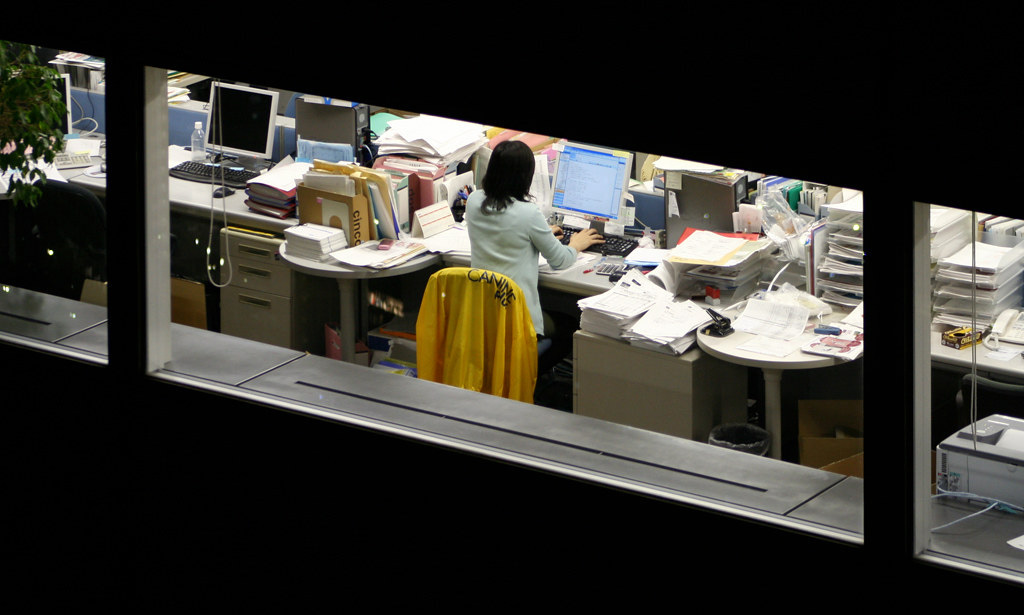
Americans who go to Japan as tourists only see the good stuff and not the bad, because they aren’t working. They shop and play in the beautiful safe cities all day long, while the Japanese people who keep those cities running are stuck in dingy open-plan offices until all hours of the night.
The point here is not that Japanese lifestyles are horrible compared to American lifestyles — that’s partly a matter of taste. Nor am I claiming that long hours of toil and drudgery are necessary for long lives and safe beautiful cities. I do not believe they are; I don’t think there’s actually a tradeoff here. But if you want to include unmeasured amenities in comparisons of living standards, you should include all of them, or at least as many as you can.
If the non-monetary differences between Japanese and American lifestyles are a bit ambiguous, the monetary differences are incredibly clear.
Let’s start with salaries. The Japanese government takes surveys of starting salaries, and the good folks at RealEstateJapan have a handy table breaking down the 2019 numbers for us:
The starting salary for a college graduate just before the pandemic was 210,200 yen per month. At current exchange rates, that’s $1338.23 per month, or just about $16,000 per year.
That’s incredibly low. That’s barely above the poverty line for a single individual in the United States, and it’s below the poverty line for a family. And that is the starting salary of a college graduate.
It’s actually not quite that horrible, for two reasons. First, Japanese companies also pay semiannual bonuses. For workers in their early 20s, these add up to somewhere around 300,000 yen a year; for workers in their late 20s, closer to 800,000 yen a year. At current exchange rates, that would correspond to about $1900 for an early-20s worker and $5000 for a late-20s worker.
But including those bonuses still leaves starting salaries for college graduates in Japan at somewhere between $18,000 and $21,000. Those are still poverty wages!
There’s a second factor we need to take into account here, which is that Japanese prices are lower — $18,000 goes farther in Japan than it does in America. This is why we like to use PPP to compare living standards. The World Bank’s PPP conversion factor for Japan is about 1.5. So after taking prices into account, an early 20s college grad in Japan can expect to make about the equivalent of An American making $27,000 a year.
For reference, American college graduates made about $51,500 in 2019. That’s almost twice as much as their counterparts in Japan, after you take local consumer price differences into account.
This difference gets a bit less as workers get older — Japanese companies tend to pay based on seniority, while American companies tend to pay more based on performance, so Japanese full-time employees usually get to enjoy a more steady, predictable upward career path (part-time employees and contract workers are, on the other hand, kind of screwed). But the tradeoff there is that the Japanese full-time workers have a lot less motivation to stand out, take risks, learn new skills, or come up with new ideas, because their promotions and raises will depend on seniority more than on their own personal accomplishments. And in any case, even when Japanese workers reach the peak of their careers, their American equivalents still get paid a lot more than they do, even if it’s no longer twice as much.
So Japanese people are out there working long hours for wages that would make Americans rebel. Think about it — in your 20s, after graduating from your university, how would you have liked to go nose-to-the-grindstone day after day for the same salary that a McDonald’s fry cook makes in America? (Of course, blue-collar wages in Japan are even lower, as the table above demonstrates.)
Those monetary differences translate into real differences in consumption. Let’s take housing, which is the biggest item in both Japanese and American budgets. Japanese houses are actually average by rich-country standards, but still much smaller than American ones. Here’s residential floor space per capita:
Similarly, in terms of residential rooms per person, Japan scores a very respectable 1.9, but Americans come in at 2.4.
Japan has come a long way since the tiny “rabbit hutches” of the 1980s, but a typical one-person apartment in urban Japan now looks like the one at the top of this post, except less stylish and elegant, and with less natural light. Americans walking through the beautiful metropolis of Tokyo, sampling its well-appointed boutiques and restaurants, have no idea of the kind of private domestic spaces the people around them are returning to at night — small tenements similar to what you’d find in New York City, except much less well-furnished. I certainly didn’t mind living in places like that when I was 23 years old, because being in Japan was an adventure — but most Americans would balk at that.
As for the single-family homes that Japanese families prefer, those look like this:
This is very far from a shack, but it’s also far from what a middle-class American would aspire to. There’s no yard, the facade is plain and cheap-looking, and the size isn’t very impressive.
Besides housing, what else can Japanese people buy less of? Vacations, for one, since as I mentioned, Japanese people take much less time off. Also, food. Americans who go to Japan and eat out at the nice restaurants there don’t realize how rarely the average Japanese person can afford to eat at places like that.
Appliances, too — Japanese clothes dryers don’t really dry your clothes, and central AC is a rarity. As incomes have diverged between America and Japan over the last two decades, I’ve noticed Americans buying all kinds of new modern conveniences — air fryers, Instant Pots, projectors, sound systems, and so on. As far as I can tell, most of these are still rare in Japan.
A fourth example is pet care — Japanese rabbit keepers will tell you that a pet rabbit’s expected lifespan is 6 to 8 years, while American rabbit keepers will tell you it’s 10 to 14, because of the differences in veterinary care. A fifth example is transportation — a $2 train ride is nothing to an American tourist, but middle-class Japanese people are sensitive about their travel budgets.
Basically, the answer to what Japanese people can’t buy as much of is “almost everything”. They can actually buy about the same amount of health care, since prices are tightly controlled. But otherwise, Japanese people just live with a bit less of everything.
And yes, poverty exists in Japan — a substantial amount of it. I wrote about this for Bloomberg back in 2019:
Japan has a relatively high number of poor people for an advanced country. Defined by the percentage of the population earning less than half of the median national income, Japan’s poverty rate is more than 15% — a little lower than the U.S., but considerably higher than countries such as Germany, Canada or Australia:
Japanese poverty is a quiet affair. There are almost no slums or shantytowns. The streets are generally clean and well-kept. Homeless people sleep out of sight. So-called evaporated people leave their homes and families and eke out meager, anonymous existences. Single people live in tiny bare apartments little larger than a closet. Elderly people who never recovered from the economic bust of the 1990s suffer in the shadows. Many shop at 100-yen stores (similar to dollar stores) just to survive.
Children are going hungry too. Almost 14% of kids, or some 3.5 million in all, are estimated to live in poverty — and that’s already down from a peak of more than 16% in 2012. To combat the problem, local governments around the country are opening thousands of cafeterias where children can eat for free.
And in 2020, Bloomberg’s Marika Katanuma wrote about how women often bear the brunt of this poverty:
According to government data, the monthly cost of living for a Japanese household with more than two people is 287,315 yen ($2,650). Some 15.7% of Japanese households live below the poverty line, which is about $937 per month.
More than 40% of part-time working women earn 1 million yen ($9,100) or less a year, according to Japan’s Internal Affairs and Communications Ministry. The lack of benefits, job security and opportunity for advancement—hallmarks of full-time employment in Japan—make such women financially vulnerable, particularly if they don’t have a partner to share expenses with.
Americans typically just don’t see this when they travel to Japan. Poverty in the country is hidden — city parks used to have sections where homeless people could pitch their tents, but the need to cater to the tourism boom has done away with that custom. Japanese people’s economic struggles occur in private spaces, between their apartments and their workplaces.
When American tourists go to the urbanist Disneyland that is Tokyo, they’re going there on an American salary. What’s more, they’re going at a time when the yen is incredibly weak against the dollar. When I lived in Japan for the first time in the 2000s, a dollar could buy between 105 and 120 yen — now, it’s close to 160. That means Americans can live very high on the hog on their trips to the Land of the Rising Sun. The country feels rich to them because in that country, they are rich. A lot richer than most of the people they see on the street.
The purpose of this post is not to bash or shame Japan — the stagnant economy is simply a huge challenge that needs to be overcome, and in fact I have a few ideas for how to do this. I’ll write more about that later. But the purpose of this post is to remind Americans how good they actually have it. Declaring America to be a third-world shithole has become fashionable on all parts of the political spectrum these days, and sure, America has plenty of problems that need to be solved. But just for once, I wish Americans would realize how ahead of the pack their country is in so many regards.